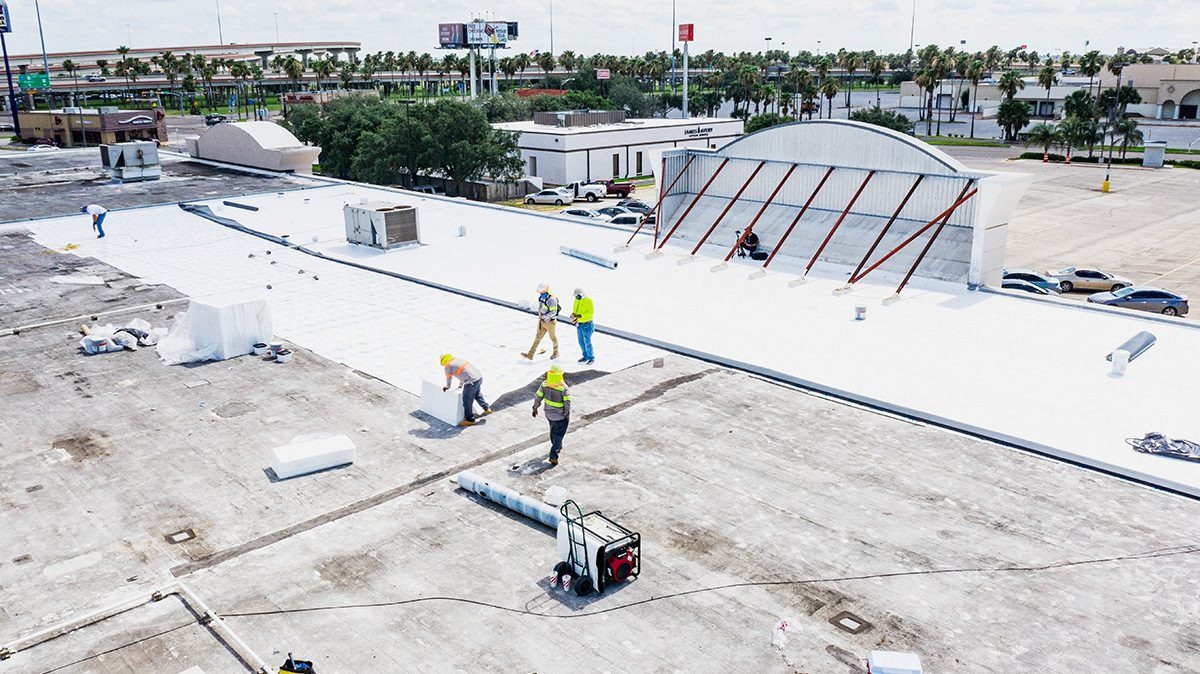
Commercial Solar Roof Integration in Minneapolis, MN
The Roofing Half of Every Minneapolis Rooftop Solar Project
A photovoltaic array looks like a power decision, but for the building owner it is mostly a roofing decision wearing a solar costume. The panels, the inverters, the wiring and the production estimate all belong to the solar contractor. The membrane those panels sit on, the holes that hold them down, the weight the deck has to carry and the warranty that keeps the building dry belong to us. We handle that half for commercial property owners across Minneapolis, and we have learned that the projects which go badly almost never go badly because of the electronics. They go badly because nobody owned the roof.
Minneapolis has real reasons to put solar on flat commercial roofs right now. Xcel Energy's Solar Rewards incentives, the city's Climate Equity Plan, and the simple fact that the metro is full of wide, unshaded low-slope rooftops have pushed owners along Hiawatha Avenue, through the Mid-City Industrial area, and across the warehouse and distribution stock near the I-35W and I-94 interchange to look at their roofs as revenue. Those roofs are excellent candidates electrically. Many of them were never designed to carry an array, and that gap is exactly where we do our work.
Penetrations Are Holes in the Thing Keeping Water Out
Every mounting foot, post or stanchion that anchors a panel field is a deliberate puncture through a membrane whose entire purpose is to stop water. People forget that because the holes are small and the array is impressive. The roof does not forget. On a Minneapolis roof that freezes and thaws from roughly October into April, a marginal penetration does not simply weep, it ratchets open a little further every time water gets inside the flashing and turns to ice.
We detail those attachments the way we would detail any curb or pipe boot, because that is precisely what they are. How we do it depends on the membrane:
- On TPO and PVC we hot-air weld penetration pockets and prefabricated curbs into the sheet so the attachment becomes part of the roof, not a bead of sealant waiting to fail two winters from now.
- On EPDM we use cured flashing and the racking manufacturer's compatible boots, set with the correct primer and adhesive for that specific rubber sheet rather than whatever is on the truck.
- Whenever the structure allows it, we steer the design toward ballasted, non-penetrating racking that holds the array with weight instead of fasteners, which removes the leak path entirely.
Sequence is half the battle. We want every penetration set, flashed and photographed on an open roof before the solar crew lands a single panel. Detailing bare membrane is cheap and reliable. Chasing a leak underneath a fully populated array, after the fact, is neither.
Weight, Wind Uplift and a Minneapolis-Sized Snow Load
Solar loads a roof in three directions at once. Panels, racking and ballast add permanent dead weight. Wind moving across and beneath a tilted array generates uplift that tries to peel the assembly off the deck. And in Minneapolis, snow is not a rounding error, it is the governing case. Drifts pile against rows of tilted modules in ways a flat, empty roof never experiences, and that concentrated load comes down on the same structure now also supporting the array all winter.
So before anyone settles on ballasted versus mechanically attached, we work with the solar engineer, and a structural engineer where the situation calls for it, to confirm the deck and framing can carry the combined dead load, the Hennepin County design snow load, and the calculated uplift. Ballast defeats uplift cheaply but adds weight a tired roof may not have to give. Mechanical attachment trims weight but multiplies the penetrations we just talked about. There is no universally correct answer, only the right answer for your deck. We would much rather settle that during design than discover it after a heavy late-March snow has already loaded the building.
Matching the Membrane's Life to the Array's Life
Most arrays carry a twenty-five-year-plus warranty. Bolting one onto a membrane with eight years left in it is one of the most expensive avoidable mistakes in commercial roofing, because someday a crew has to lift and re-set the entire panel field just to replace the roof underneath. We refuse to set up that future bill quietly.
Before any panel goes up we assess the existing roof honestly and tell you what we find. If the membrane has the remaining service life to outlast the array, we detail the attachments and proceed. If it does not, we say so plainly: the responsible move is to recover or re-roof first. Installing a fresh TPO or PVC system immediately ahead of the solar work is the cleanest path there is, because the roof and the array then age on the same clock and the racking gets integrated into a new assembly instead of retrofitted onto a worn one. We also confirm the racking components are chemically compatible with the sheet, since some metals and plastics degrade single-ply membranes on prolonged contact.
Keeping the Two Warranties From Colliding
This is where rooftop solar projects quietly come apart, and it has nothing to do with the panels. The moment two trades touch the same roof, manufacturers start asking who is liable for a leak. A membrane manufacturer can deny a warranty claim outright if an unauthorized contractor cut into the roof to mount equipment, and many of them will.
We protect your coverage by staying inside the manufacturer's rules from the start. That means approved penetration and attachment methods, work performed by crews the membrane manufacturer actually recognizes, and documentation of every detail so the roofing warranty and the solar equipment warranty do not point fingers at each other later. We coordinate the sequence and the attachment specifications directly with your solar installer so there is one clear, defensible chain of responsibility for the roof, with the array sitting cleanly on top of a system that is still fully warranted.
Why Minneapolis Owners Bring Us In
We approach rooftop solar from the side that decides whether the building stays dry. We are not selling you modules or a production estimate. We are making sure the surface they live on survives them, which is the part that turns into repair calls when it is handled by people whose job ends at the racking. For owners of the big-box retail, distribution and light-industrial buildings around Hiawatha, the North Loop and the freeway corridors, that focus is the line between a solar asset that pays for itself and a roof that springs leaks around the feet.
If you are planning a commercial PV installation in Minneapolis, or you already have an array and are seeing moisture around the racking, get us involved early. We will assess the membrane, work the load and warranty questions through with your solar contractor, and detail the roof so the array does its job for its full design life. Reach out and we will start with your building and your roof's current condition.