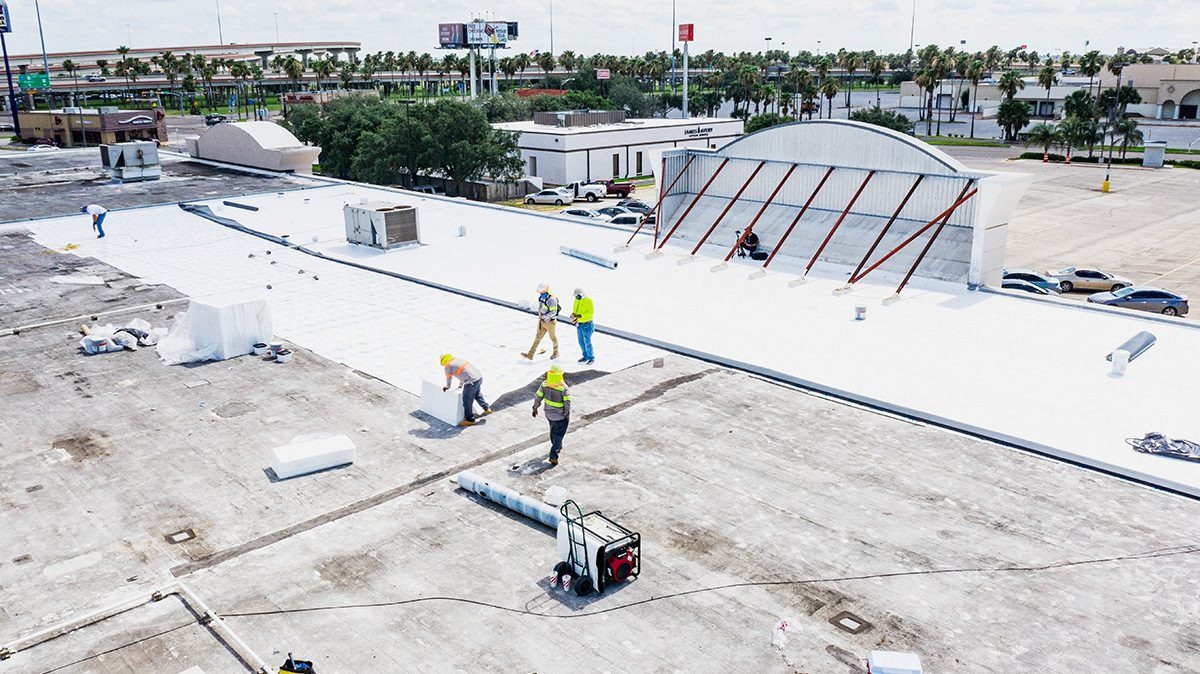
Commercial Roof Coatings in Minneapolis, MN
A coating system is not a cover-up. On a Minneapolis roof that still has a sound substrate — confirmed by moisture cores — a silicone or acrylic coating extends service life by 10 to 15 years and qualifies for a new manufacturer warranty without a tear-off.
Roof coatings get oversold in the commercial roofing market. The coating that extends a sound roof's life by 10 to 15 years is a legitimate capital planning tool. The coating applied over saturated insulation or a membrane with widespread seam failure is a temporary cover that defers the replacement cost by 18 months and masks the underlying problem from the next buyer. We do not sell the second kind.
Our coating process starts with moisture cores — typically five to ten locations per 50,000 square feet of roof area — to confirm that the insulation under the membrane is dry. On Minneapolis commercial roofs, particularly the early-2000s TPO systems on Uptown mixed-use buildings and the modified bitumen roofs on North Loop warehouse conversions, we find saturated polyiso in a meaningful percentage of roofs that look coating-eligible on a surface inspection. Saturated polyiso under a coating is a structural risk in Minnesota snow load conditions: the insulation's R-value collapses under freeze-thaw cycling, and the wet insulation board can crush under 35-psf design loads.
Buildings that pass the moisture core evaluation get a written coating recommendation that includes the specific system, application rate, estimated service life extension, and the manufacturer warranty path — including what annual maintenance the warranty requires. We specify coating systems that are compatible with Minnesota's temperature extremes: silicone coatings that stay flexible at -25°F and reflect solar load at 95°F summer ambient, not acrylic systems that crack during freeze-thaw cycling when applied at below-minimum temperatures.
Coating Systems We Apply in Minneapolis
Silicone coatings: The most durable coating choice for Twin Cities freeze-thaw conditions. Silicone maintains flexibility across the full Minneapolis temperature range — -25°F to 140°F surface temperature — and is ponding-water resistant, which matters on flat roofs where drain design does not always provide perfect positive drainage. Silicone coatings are our default recommendation for buildings in the Downtown core, the North Loop warehouse district, and the Eden Prairie corporate corridor where ponding water is documented during inspection.
Acrylic coatings: Lower installed cost than silicone, appropriate for roofs with good positive drainage and in applications where the coating will be applied and allowed to cure before freeze-thaw season. We do not apply acrylic coatings after October in the Twin Cities — the cure requirements are not compatible with the November through March freeze-thaw cycle. On the Edina Southdale retail corridor and Bloomington commercial buildings near Mall of America where drainage is well-maintained, acrylics are a cost-effective option when applied in the May through September window.
Polyurethane coatings: Higher compressive strength than silicone or acrylic — appropriate for roofs with significant foot traffic, rooftop equipment access, or ballasted areas. On buildings near MSP airport and the Eden Prairie tech corridor where rooftop mechanical equipment requires frequent access, polyurethane foam with elastomeric top-coat is a durable option that handles the compression and abrasion from technician foot traffic.
Metal roof coatings: The industrial inventory in Northeast Minneapolis, Brooklyn Park, and Maplewood (including buildings near the 3M campus) includes metal roof systems that develop rust, seam separation, and panel joint failures. Silicone-based metal roof coatings applied over cleaned and primed steel can extend service life by 15 years and eliminate active seam leaks without structural modification.
The Minneapolis Coating Eligibility Evaluation
A coating is a capital tool, not an emergency repair. We do not coat a roof that is actively leaking without first identifying and repairing the failure location — coating over an active leak seals the leak from above while the water continues to accumulate in the insulation below. We perform the following evaluation on every coating candidate:
Moisture core pulls in 5 to 10 representative locations — concentrated near drains, parapet walls, and known or suspected repair areas where insulation saturation is most likely. Any cores that read wet disqualify the immediate coating scope. We then develop a partial replacement scope for the wet zones, with coating applied after the insulation replacement is complete and confirmed dry.
Membrane adhesion test: Coating adheres to the existing membrane, not to the insulation — the existing membrane surface must be in adequate condition to accept and hold the coating bond. We test adhesion by applying and pulling a sample strip before pricing the full project. Failed adhesion on a modified bitumen roof often indicates oxidation that requires primer application; failed adhesion on an EPDM roof can indicate silicone contamination from prior product applications.
Seam and flashing inspection: A coating does not reinforce a failing seam. Every seam on the coating candidate roof gets a manual pull test and probe before coating. Failing seams are repaired with in-system material before coating is applied — the coating bridges minor surface texture, not structural seam openings.
Capital Planning Value in the Twin Cities Market
For facilities directors at the UnitedHealth Eden Prairie campus, the Target corporate portfolio in Brooklyn Park and Downtown, and the multi-building office parks along Prairie Center Drive in Eden Prairie, a coating cycle represents a documented capital deferral — a 10-to-15-year service life extension at 30 to 50 percent of full replacement cost. We document the coating project with the same closeout package we provide on replacements: moisture core results (pre and post), photo-keyed zone diagram, applied coating system and lot numbers, warranty documentation, and the maintenance requirements that keep the warranty active.
Annual maintenance on a coated Minneapolis roof includes a spring walk after the freeze-thaw season, a fall walk before snow loads arrive, drain clearing and lap inspection after any major weather event, and touch-up application on any areas that show wear from foot traffic or mechanical equipment contact. We include annual maintenance as a line item option in every coating proposal because the warranty is only as good as the maintenance record behind it.
Can a coating be applied to a Minneapolis roof in winter?
No, for silicone and acrylic systems. Both require substrate temperatures above the manufacturer's minimum application temperature — typically 40°F to 50°F for silicone and 50°F for acrylic — and 24 to 48 hours of above-minimum temperatures during the cure window. Minneapolis commercial coating season is May through early October, with the best installation window being June through September. Polyurethane foam has somewhat lower minimum application temperatures but is not applied in precipitation or on frost-covered substrates.
How long does a commercial roof coating last in Minneapolis?
A properly specified silicone coating on a sound, dry substrate in Twin Cities conditions is expected to provide 10 to 15 years of service life extension, with performance warranties of 10 years available from major manufacturers. Acrylic coatings in appropriate drainage conditions run 7 to 10 years. Service life varies based on foot traffic volume, maintenance record, original substrate condition at time of application, and UV exposure. We document all pre-application conditions so the warranty claim baseline is defensible if needed.
Does a coating void my existing roof warranty?
It depends on the existing warranty terms and the coating manufacturer. Many major roofing manufacturers (Carlisle, Firestone, GAF, Tremco) offer coating products that are approved for application over their membrane systems and that reset or extend the warranty term when applied. We specify coatings that are compatible with the existing system's warranty terms and document the manufacturer approval for the building's warranty file.
Find out if your Minneapolis roof qualifies for a coating.
We will pull moisture cores, test membrane adhesion, inspect every seam and flashing, and give you a written assessment — with the coating scope and warranty path if the roof qualifies, and the replacement scope if it does not.
- Office Building Roofing
- Commercial Reroofing
- Commercial Roof Repair
- Hail Damage Roof Repair Service
- Roof Recover Systems
- Healthcare Facility Roofing
- Built Up Roofing
- About