Logistics & Distribution Facility Roofing Minneapolis
Distribution centers and logistics facilities in the Twin Cities metro run continuous receiving and shipping operations that a roofing project cannot interrupt. MSP Airport's cargo complex in Bloomington, Target's distribution network across the metro, and the dense logistics corridors along I-494 and I-694 all have large-footprint roofs where the section-by-section sequencing plan is as important as the membrane selection.
Minneapolis-St. Paul International Airport's cargo complex in Bloomington handles freight operations for the major cargo carriers and integrated logistics providers serving the upper Midwest. The cargo apron buildings and ground-handling facilities have large-footprint flat roofs with dock-high doors, extensive rooftop mechanical systems, and aircraft-exclusion zones that govern where contractors can position equipment and vehicles. Roof work on MSP cargo facilities requires coordination with the Metropolitan Airports Commission, the FAA obstruction clearance requirements for equipment near the airfield, and the individual cargo carrier's operational protocols.
Target Corporation's distribution network spans multiple facilities in the Twin Cities metro, including the primary distribution center in Brooklyn Park and several regional fulfillment centers positioned to support the metro's store network. Target distribution buildings run 20-hour-per-day receiving and shipping operations, with dock doors cycling continuously. A roofing project on a Target distribution facility is scheduled around the facility's peak-volume calendar — holiday buildup periods from October through December are no-major-project windows.
The I-494 south corridor and the I-694 north corridor host some of the largest concentrations of modern logistics and distribution facilities in the upper Midwest. These buildings — typically tilt-up concrete construction with steel deck roofs, built between 1995 and 2020 — are at various stages of their first major maintenance or recover decision. Many were built with TPO single-ply membrane that is now 15–25 years old and approaching the end of its warranted service life.
Large-Footprint Distribution Center Sequencing
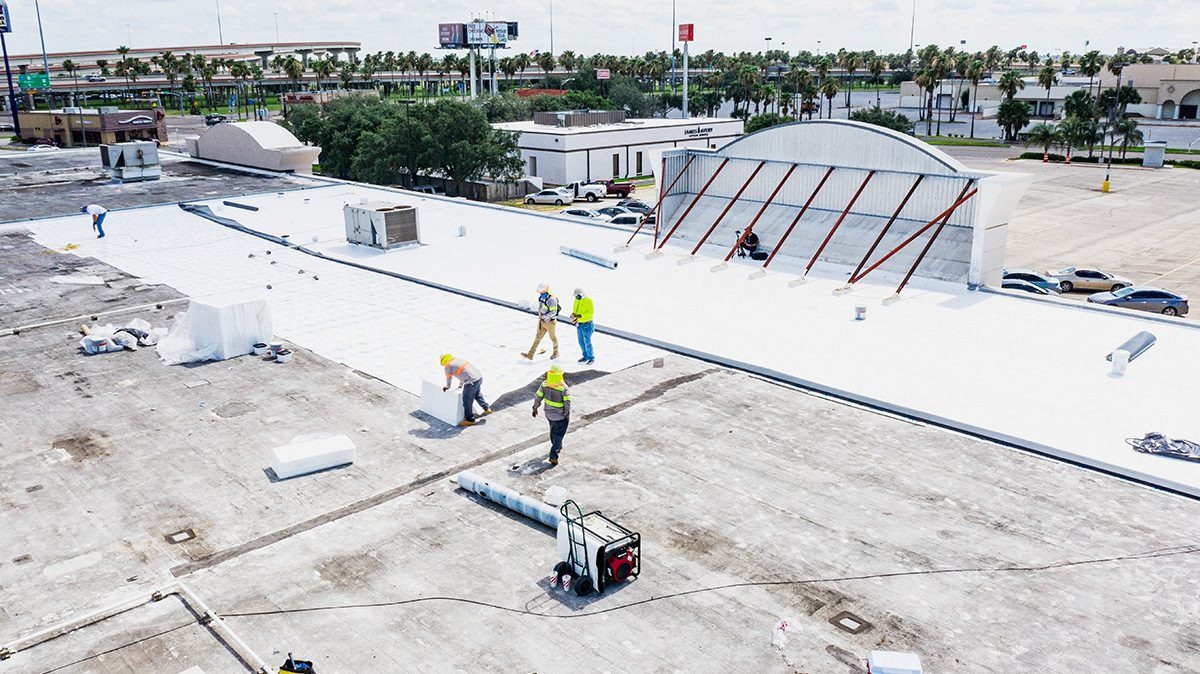
A 400,000 sq ft distribution center is not a single roof project — it is 15–20 sequenced section projects, each completed and dried in before the next section opens. Section boundaries are mapped to the building's structural bay layout and to the positions of dock-door banks below — we do not open a roof section above an active dock bank during the receiving shift if the section cannot be dried in by the end of that shift.
Material delivery to a distribution facility is not the same as delivery to an office building. Roofing materials arrive by flatbed truck, and the facility's dock scheduling team controls which docks are available and at what times. We coordinate material delivery schedules with the facility's logistics coordinator before production starts and use staging areas outside the active dock zone to minimize impact on shipping and receiving operations.
Fork truck and yard tractor movement on the concrete apron around distribution buildings creates a constrained staging environment. Crane outrigger positions, material pallets, and contractor vehicles all have to share the apron with the facility's own freight equipment. We map equipment positions with the facility manager during pre-construction and adjust crane outrigger positions to clear the freight lanes.
MSP Airport Cargo Complex Protocols
Work on facilities within the MSP Airport perimeter requires contractor badge and background check clearance from the Metropolitan Airports Commission. All contractor vehicles operating on the airport must be badged, and personnel working airside (inside the security perimeter) must have SIDA (Security Identification Display Area) clearance or escort. We initiate the MAC badging process before project start — this can take 2–3 weeks and must be built into the pre-construction schedule.
FAA obstruction requirements govern the maximum height of equipment near the airfield. Crane boom heights in the cargo apron area must be cleared against the airport's crane permit requirements, which are issued by MAC in coordination with FAA. We obtain the crane permit before mobilization and operate within the approved height envelope. Night-lighting requirements for equipment left on the airfield overnight are also governed by MAC's permit conditions.
Cargo facility roofs in the MSP complex have specific considerations around jet blast exposure in areas adjacent to aircraft aprons. Membrane uplift resistance specifications for facilities near active aircraft parking positions must account for the additional wind and thermal loading from jet blast events. We review the building's position relative to the aircraft apron and specify membrane attachment accordingly.
Cold-Storage and Refrigerated Distribution Facility Considerations
The Twin Cities metro has a significant cold-storage and refrigerated distribution sector serving the food and pharmaceutical supply chains. Cold-storage facilities have a roofing challenge that ambient-temperature buildings do not: the vapor drive through the roof assembly reverses seasonally in Minnesota's climate, creating a condensation risk within the insulation if the vapor barrier is not correctly positioned. We specify vapor barrier placement for cold-storage roofs based on the interior operating temperature and the Minnesota climate zone — a standard commercial insulation stack is not appropriate for a facility running at 35°F or 0°F interior temperatures.
Roofing work on occupied cold-storage facilities requires maintaining the interior temperature throughout the project. We do not leave a section of cold-storage roof open past the point where the facility's refrigeration system can maintain target temperature — the inventory below (food, pharmaceuticals, or other temperature-sensitive products) is at risk if the thermal envelope is compromised. Production in cold-storage sections is planned and executed in smaller daily sections than ambient-temperature buildings to maintain thermal continuity.
Do you hold the badging and clearances required for MSP Airport cargo facility work?
We initiate the MAC contractor badging and background clearance process at the start of pre-construction for any project within the MSP Airport perimeter. SIDA clearance for airside work is obtained through the MAC's standard process, which typically runs 2–3 weeks. We build this lead time into the project schedule and do not assume we can mobilize on a compressed timeline.
How do you handle a 400,000 sq ft distribution center roof replacement without shutting down operations?
We scope the project in sections sized to complete and dry in within a single work shift, with section boundaries mapped to the building's structural bays and dock-door positions. No section is left open overnight. Material staging and crane positions are coordinated with the facility's logistics team before production starts. The project schedule includes daily completion targets that the facility manager can track against the production plan.
What is the vapor barrier specification for a cold-storage facility in Minneapolis?
For refrigerated buildings operating below 40°F in the Twin Cities climate, the vapor barrier must be positioned on the warm side of the insulation — typically at or below the structural deck — to prevent condensation within the insulation stack. The specific vapor barrier specification depends on the interior operating temperature. We review the facility's operating temperature and refrigeration system design before finalizing the insulation and vapor barrier specification.
Get a distribution facility roofing scope.
Our project managers will walk the roof, review dock operations and peak-volume calendar with your facility manager, and produce a written scope that maintains continuous operations throughout the project.
- Agricultural Food Roofing
- Data Center Roofing
- REIT Roofing
- Healthcare Roofing
- Manufacturing Industry Roofing
- Drain Cleaning Repair
- Auto Dealership Roofing
- Preventive Roof Maintenance