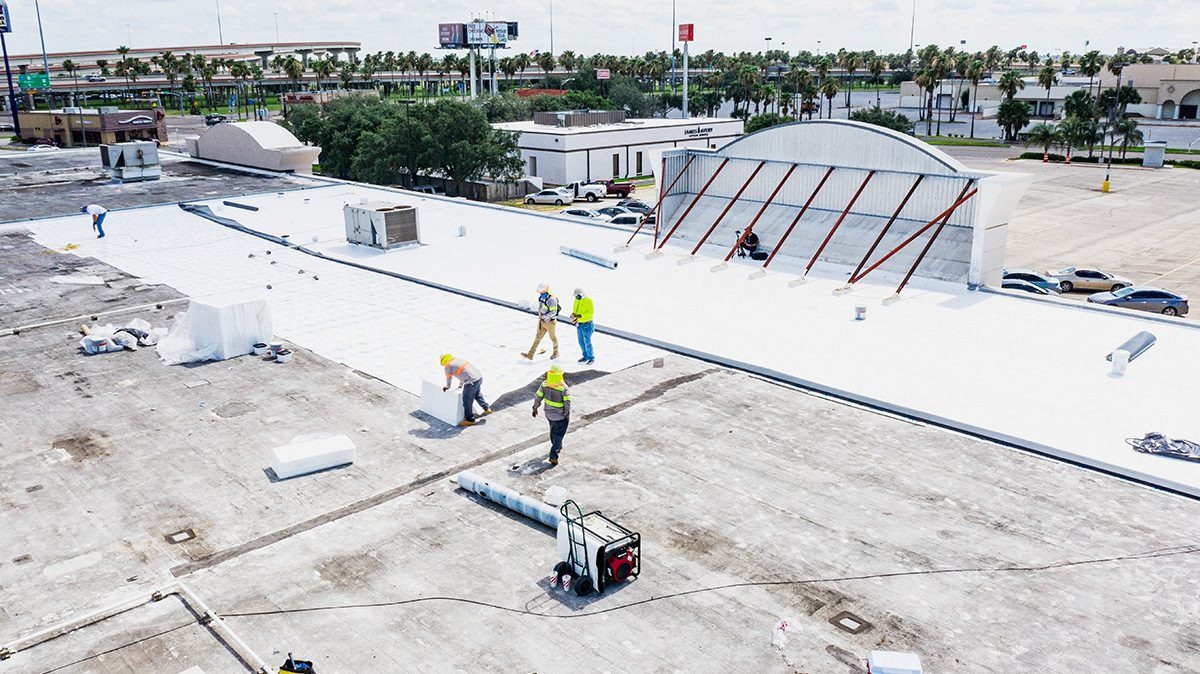
PVC Roof Systems Minneapolis — Chemical-Exposure & Restaurant Roofing
PVC membrane handles what TPO and EPDM cannot: grease-exhaust exposure, animal fats, and chemical fallout from rooftop equipment. We install PVC 50-mil and 60-mil systems on Twin Cities restaurants, food-processing buildings, and chemical-exposure industrial facilities — with 25-year manufacturer warranty paths available.
PVC (polyvinyl chloride) membrane is the specification for one specific category of Minneapolis commercial buildings: any building where the rooftop is regularly exposed to grease, The restaurant clusters on Hennepin Avenue, the food-processing facilities in the Northeast Minneapolis industrial zone, and industrial buildings in the Midway corridor that handle petroleum-based solvents — these buildings destroy TPO and EPDM membranes in years, not decades, when the exhaust or chemical exposure lands on the roof surface.
The reason is chemistry. TPO and EPDM are not formulated to resist oils and fat-based compounds. Grease exhaust from a commercial kitchen condensate hood, even moderate exposure accumulated over five to eight years, softens and degrades both membranes around the exhaust equipment. PVC is plasticizer-based and resists this category of exposure reliably — the Sika Sarnafil systems we install carry a 25-year warranty, and the manufacturer's warranty exclusions do not carve out grease exposure the way competitors' warranties do. For Minneapolis restaurant buildings that cycle through high-humidity summer kitchen operations and extreme winter cold, a membrane with documented chemical resistance and flexibility across the full temperature range is not optional — it is the correct specification.
The trade-off is cost: PVC runs higher than TPO per installed square foot, and the material requires more careful handling in cold-weather installation conditions common in the Twin Cities. For buildings where chemical exposure is not a factor, we do not specify PVC. But for the building where grease or chemical exposure is the failure mode, the cost premium recovers in warranty longevity and avoided premature replacement.
Twin Cities Buildings That Require PVC
Restaurants and food-service buildings: Any Minneapolis restaurant with rooftop exhaust equipment vents grease-laden air across the roof membrane. The condensate from that exhaust accumulates at the membrane around the exhaust hood and works into any seam or lap in the exposure zone. We survey the exhaust equipment placement before specifying membrane type. Buildings on Hennepin Avenue's restaurant corridor, the North Loop mixed-use restaurant blocks, Uptown's dense food-and-beverage strip along Lake Street, and the Northeast Minneapolis restaurant district get PVC specifications when we write the scope.
Food processing and cold storage: Several Twin Cities food-processing facilities in Northeast Minneapolis and the Midway area run 24-hour operations with high-wash rooftop environments and ammonia refrigeration systems. PVC handles ammonia and most industrial cleaning agents that would degrade TPO over time. The same cold-chain facilities near MSP Airport in Bloomington and Richfield that cycle between deep-freeze interior temperatures and Minnesota exterior conditions benefit from PVC's chemical resistance and low-temperature flexibility.
Industrial chemical operations: Dry-cleaning plants, printing facilities, and light chemical manufacturing in the older commercial stock across South Minneapolis, the Midway corridor, and Northeast industrial zones exhaust solvents and chemicals that attack standard membrane formulations. PVC's chemical resistance profile covers most of the compound classes that these operations vent. We assess the specific chemical exposure environment as part of every PVC scope recommendation.
Sika Sarnafil and Other PVC Manufacturers for Minnesota Projects
Sika Sarnafil is our primary PVC specification for Twin Cities projects. Their 25-year warranty on qualifying PVC installations is the longest in the industry for this membrane type, and their formulation has a strong performance record in Minnesota's wide temperature range — from summer ambient temperatures in the upper 90s to winter extremes well below zero. Sarnafil's G-476 and TS-77 systems are what we install on most Minneapolis commercial PVC projects. Their cold-weather installation guidelines are well-developed for northern climate applications.
Other PVC manufacturers we work with include Duro-Last, which offers prefabricated systems where the membrane is cut and sealed in a factory environment to reduce field seaming. This approach is relevant for Minneapolis restaurants and food facilities where the rooftop has dense equipment layouts requiring numerous custom penetration details — factory-prefabricated flashings reduce the field seam count at the highest-risk locations. We match the manufacturer to the project geometry and the owner's warranty objective.
PVC Cold-Weather Installation in Minneapolis
PVC heat-welding in cold weather requires heated welding equipment rated for cold ambient temperatures and careful substrate preparation to remove frost and condensation before seaming. The heat-welded seam on PVC creates a permanent bond that is the full strength of the membrane — but only if the seam is executed at the correct weld temperature with a dry, properly primed substrate. We test every seam on PVC projects with a probe and a peel-test sample before proceeding to adjacent work areas.
Minimum installation temperature for PVC bonding adhesives is 40°F substrate temperature. In Minneapolis, this means PVC fully adhered installation is practical from late spring through early fall. For project schedules that extend into colder months, we phase the installation to complete adhered field areas during the warmer installation window and sequence the detail work for periods when substrate temperatures are within the adhesive range. We do not substitute bonding conditions to hit a schedule — a delaminated PVC seam discovered during the manufacturer's warranty inspection voids the closeout process entirely.
My Minneapolis restaurant keeps failing around the exhaust hood on TPO. Is PVC the answer?
Almost certainly yes, if the failure pattern is at or near the grease-exhaust equipment. We do a targeted inspection at the failure areas, pull moisture cores around the exhaust hood, and assess whether a localized PVC repair zone or full PVC replacement is the right scope. In cases where the building is otherwise a solid recover candidate, we sometimes specify a PVC hybrid — replace the grease-exposure zone around the hood with PVC and recover the remaining roof field with TPO or EPDM. That hybrid approach costs less than full PVC while solving the specific chemical failure mode.
Does PVC hold up to Minneapolis freeze-thaw cycling?
PVC's plasticizer chemistry keeps the membrane flexible across a wide temperature range, and modern Sika Sarnafil formulations are rated for cold-climate performance. PVC systems we have inspected on Twin Cities food-service buildings from the mid-2000s are in serviceable condition — that is a real-world performance data point for Minnesota conditions. The failure modes we see on aging PVC in the Minneapolis market are plasticizer migration on very old pre-2000 formulations and seam failures on systems that were installed at low temperatures without proper substrate preparation, not material brittleness at operating temperature.
Is PVC more expensive than TPO for Twin Cities buildings?
Yes — typically 15 to 25 percent higher per installed square foot than TPO of equivalent thickness. For buildings where chemical or grease exposure is not a factor, the premium is not justified. For restaurants, food-processing operations, and chemical-exposure industrial facilities in the Twin Cities, the longer warranty life and avoided early replacement easily recover the upfront cost difference over the system's lifecycle.
- Standing Seam Metal Systems
- Silicone Roof Coating Systems
- Spray Polyurethane Foam Systems
- Cool Roof Systems
- Ballasted Roof Systems
- School Roofing
- Solar Roof Integration
- Hail Damage Roof Repair Service