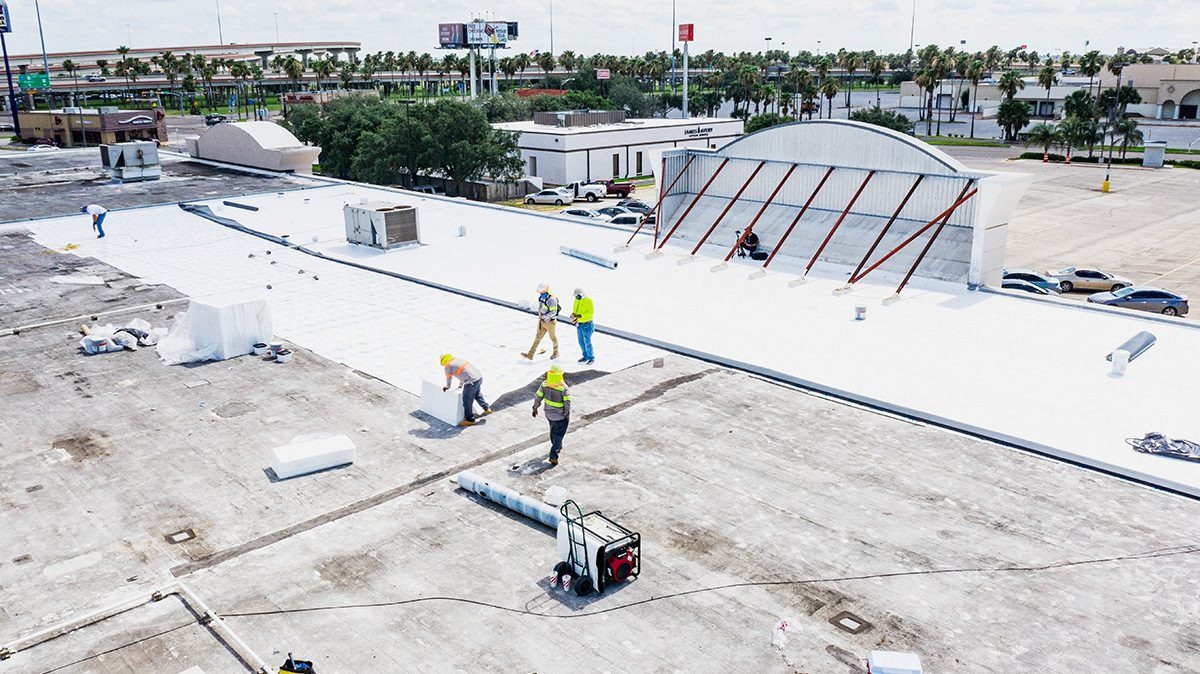
Commercial Roof Capital Planning — Minneapolis
A commercial roof replacement in the Minneapolis market costs more in emergency mode than in planned mode — typically 20 to 35 percent more once you factor in emergency premium labor rates, expedited material delivery, winter production inefficiencies, and tenant disruption costs.
Capital planning for commercial roofs in the Twin Cities metro requires two things that most roofing contractors cannot provide: honest condition assessment and independent cost projection. The contractor who wants the replacement job has an incentive to accelerate the timeline. The property manager who wants to defer capital has an incentive to extend it. Neither perspective produces a defensible number for a capital reserve schedule.
Our capital planning work is disconnected from replacement sales. When we produce a capital forecast for a building owner or asset manager, the forecast is based on the documented condition of the roof, the expected service life of the membrane system in the Minneapolis climate, and market cost data for replacement work in the current Twin Cities contracting environment. The forecast is useful whether we do the eventual replacement work or not.
Minneapolis commercial roofs require capital planning that accounts for Minnesota-specific accelerators. TPO membranes on roofs with inadequate tapered insulation drainage systems age faster in the Twin Cities because freeze-thaw ponding cycles degrade the membrane at the seam line. Modified bitumen roofs on older North Loop warehouse buildings age faster when the structural deck has begun to deflect from decades of snow load cycling. These are condition factors that change the service life estimate from a generic industry average to a building-specific projection.
How We Build a Capital Forecast
Step one is the baseline condition inspection. We walk the roof, pull moisture cores where saturation is indicated, photograph all noted conditions, and produce a condition score on a standardized scale. The condition score is the starting point for the service life estimate.
Step two is service life projection. We apply Minneapolis-climate adjustment factors to the manufacturer's rated service life for the membrane type — a TPO membrane rated for 25 years in a mid-Atlantic climate operates differently on a Minneapolis building with a 50 psf design snow load, ice dam pressure at the parapets, and freeze-thaw cycling from -25 degrees to 140 degrees Fahrenheit on the membrane surface. The adjusted service life estimate is a range — not a single year — because condition deterioration is not linear.
Step three is replacement cost projection in current-year dollars, with a simple escalation factor for future-year planning. Minneapolis commercial roofing costs are driven by labor market conditions in the Hennepin County construction trades, material pricing from the regional distribution network, and winter production premium — projects that run November through March cost more in labor than summer projects on equivalent scopes. We use current bid data from our active project pipeline to calibrate the cost projection.
The output is a one-page capital schedule per building: current condition score, estimated replacement window (five-year range), current-dollar replacement cost, and annual reserve accrual recommendation. For portfolio owners with multiple buildings across the Minneapolis metro — from the Whittier and Powderhorn neighborhoods to the Bloomington and Richfield south suburban corridors — we produce a portfolio-level capital summary that aggregates all buildings.
When Capital Planning Changes the Replacement Decision
A capital plan sometimes changes the timing decision in both directions. A building owner who assumed a roof had five years left sometimes discovers — after a documented moisture core survey — that the insulation saturation level makes replacement a now decision rather than a deferred one. Saturated polyiso in a Minneapolis winter carries a structural load premium that changes the risk calculation. A building that can carry the replacement cost this year avoids the emergency premium and the structural risk; a building that defers may carry a real snow-load risk through the next winter season.
The reverse also happens. Buildings whose owners have been told by incumbent contractors that replacement is imminent sometimes have documented condition scores that support two to four more years of maintained service under an extended maintenance scope. We produce capital plans that are honest about both directions.
Integration with Lender and Investor Requirements
Commercial mortgage lenders and CMBS underwriters require capital reserve documentation for commercial property refinancing. The Twin Cities commercial real estate market — particularly the North Loop office and multifamily inventory and the Eden Prairie and Bloomington corporate campus market — has seen significant refinancing activity in the past several years. Lenders require a condition report and capital reserve estimate from a qualified roofing contractor. We produce these reports in formats compatible with standard lender requirements and can turn them around on the timeline that commercial closings require.
How far in advance should Minneapolis building owners start capital planning for a roof replacement?
Three to five years before the expected replacement is the useful planning window. That gives time to fund the capital reserve, select the replacement scope through a competitive process, and avoid being pushed into an emergency replacement timeline. Minneapolis buildings that defer planning past this window often end up replacing in winter — which is entirely possible with proper sequencing, but costs more than a summer or fall project.
What is the typical cost range for commercial roof replacement in Minneapolis?
Current Minneapolis market pricing for a full tear-off and replacement ranges roughly from $12 to $22 per square foot for standard TPO and modified bitumen systems on low-slope commercial roofs, depending on deck condition, insulation stack, parapet height, and access conditions. Recover systems without tear-off run lower. Specialty systems, complex roof geometries, and winter production add to the base cost. We provide a specific cost projection after a condition inspection — general ranges are useful for budgeting; actual numbers require a scope.
Can you produce a capital reserve report for a lender-required property condition assessment?
Yes. We produce capital reserve reports that meet the documentation requirements for commercial mortgage underwriting, including current condition narrative, documented inspection with photographs, remaining service life estimate, and replacement cost projection in current and escalated future-year dollars. We coordinate directly with property condition assessment firms when the lender requires an integrated PCA report.
Get a capital plan for your Minneapolis commercial roof.
We will inspect the roof, score the current condition, and deliver a written capital forecast with a replacement cost projection and annual reserve recommendation — whether you are planning a replacement, refinancing, or selling.
- Third Party Quality Inspection
- Commercial Roof Inspections
- Condition Reporting
- Roof Zone Mapping
- Maintenance Program Management
- Roof Recover Systems
- Mixed Use Roofing
- Commercial Roof Coatings