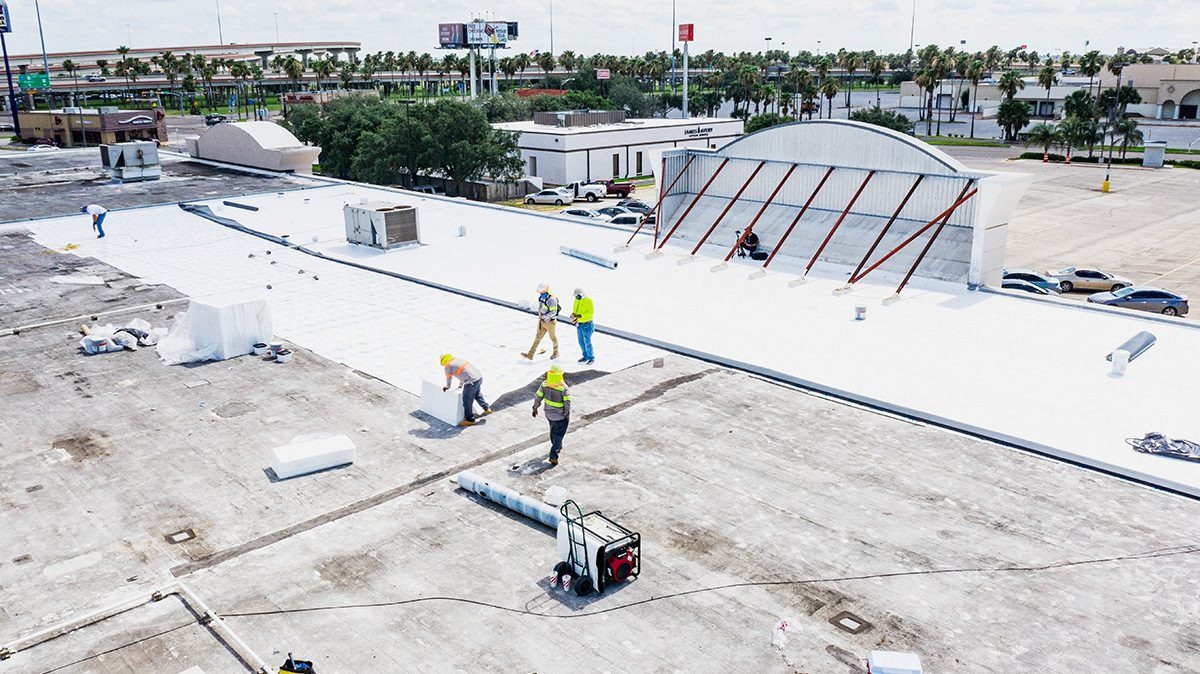
TPO Roof Systems Minneapolis — 60/80-mil Install, Recover & Warranty
TPO is the volume membrane in Twin Cities commercial roofing because it handles Minnesota's freeze-thaw cycling and snow loads, carries 20-year NDL warranty paths, and installs faster than alternatives. We specify mechanically attached and fully adhered systems against manufacturer details — not generic specs that warranty inspectors reject at closeout.
TPO accounts for the majority of Minneapolis commercial flat roof replacements we quote across the Twin Cities metro. The white membrane earns its place in Minnesota's Climate Zone 6A not only for summer reflectance but for compatibility with cold-weather installation — factory-rated cold-weather adhesives and heated welding guns allow TPO installation through the Twin Cities construction season in ways that older membrane systems could not. Every major manufacturer offers a 20-year no-dollar-limit warranty path on qualifying 60-mil installations, and the heat-welded seam is the most reliable field joint in commercial single-ply roofing.
What separates a TPO roof that lasts 25 years from one that leaks in year three is the detail work: seam width, roller pressure during weld, flashing termination at parapets, and cover board selection under the membrane. We follow the manufacturer's published detail drawings on every project because that is what the warranty inspector checks at closeout — not our internal quality standard, the manufacturer's. In Minneapolis, parapet detailing is particularly critical: the membrane must extend at least 8 inches above the design snow depth on the parapet face, and the wall-to-membrane transition must use fully-adhered flexible detailing that tolerates the ice jacking movement that occurs at parapet walls during freeze-thaw cycling.
We install TPO mechanically attached on most Twin Cities commercial buildings and fully adhered where wind-uplift requirements or occupied-building restrictions call for it. Our project managers have walked more than two million square feet of Minneapolis-area TPO in various stages of life, and we will tell you honestly whether your existing roof is a recover candidate or replacement territory before we hand you a contract. Minnesota snow load conditions complicate the recover decision: saturated polyiso insulation loses its R-value under freeze-thaw cycling and can crush under 35-psf design loads — a roof that looks like a coating or recover candidate on the surface may need replacement once the moisture core data comes in.
60-mil vs 80-mil — When Thickness Matters in Minnesota
60-mil TPO is the standard specification for Minneapolis commercial buildings with normal rooftop traffic — distribution warehouses near MSP Airport, single-story office buildings along I-494, retail strip centers across Bloomington and Edina. It carries a 20-year NDL warranty from every major manufacturer and handles Minnesota's UV, temperature extremes, and freeze-thaw cycles without accelerated degradation in current formulations. For most owners, it is the right balance of installed cost and lifecycle performance.
80-mil TPO adds meaningful value in specific situations common to the Twin Cities market: buildings with heavy rooftop equipment traffic such as corporate campus facilities in Eden Prairie and the technology corridors along Plymouth and Minnetonka, owners who want the extended warranty term some manufacturers offer on 80-mil products up to 25 years, and buildings where mechanical access routes produce elevated puncture risk from dropped tools or equipment. The cost delta is roughly $0.40 to $0.60 per square foot installed, and we model the lifecycle difference for each client so the decision is grounded in numbers and not assumptions about what a thicker membrane costs.
In the Minneapolis context, 80-mil also offers measurably better performance at the seam during winter thermal cycling. A membrane that endures a 130°F swing from peak summer surface temperatures to Minneapolis January substrate temperatures — well below zero in sustained cold events — sees significant contraction stress at the seam. 80-mil seam width allows more weld material to resist that stress, and we specify it on buildings where the seasonal temperature range and roof geometry create elevated seam stress concentration.
Mechanically Attached vs Fully Adhered for Twin Cities Conditions
Mechanically attached is the dominant attachment method for Minneapolis commercial work. The membrane and insulation are fastened through a pattern of screws and plates designed against the building's wind-uplift requirement under Minnesota State Building Code and ASCE 7. Buildings near MSP Airport in Bloomington and Richfield, and open-exposure buildings along the I-494 corridor in Eden Prairie and Minnetonka, see elevated uplift demands that we account for with tighter fastener patterns. Mechanically attached installs faster and at lower cost than adhered, and it allows thermal movement in the membrane rather than constraining it — an important design consideration given the extreme thermal range Minneapolis roofs experience annually.
Fully adhered systems bond the membrane directly to the cover board or insulation substrate using TPO-compatible bonding adhesive. We specify fully adhered when the building has deck conditions that cannot tolerate additional fastener penetrations, when the project involves historic commercial structures such as those being renovated in the North Loop warehouse district, or when the specified wind-uplift resistance exceeds what a mechanical pattern can deliver at reasonable fastener density. The trade-off is cost and adhesive sensitivity to temperature during installation — we do not install fully adhered systems when substrate temperatures are below the manufacturer's minimum, which in Minneapolis means pre-heating the substrate or scheduling production for warmer installation windows during spring, summer, and early fall.
20-Year NDL Warranty Path — What It Actually Requires
Every major TPO manufacturer offers a 20-year no-dollar-limit warranty on qualifying installations. NDL means if the roof leaks during the warranty period due to a manufacturing defect or installation deficiency, the manufacturer pays to repair it — no labor cap, no material cap. That is meaningfully different from a prorated material-only warranty, which is what discount contractors deliver even when they market it as a 20-year warranty. On a Minneapolis building where a roof failure in February means winter emergency response, active leaks, and potential ice dam acceleration, the difference between NDL coverage and a material-only warranty is not theoretical — it is a real financial difference in who pays for the repair.
Qualifying for NDL requires installation by a manufacturer-credentialed applicator, adherence to the manufacturer's published detail drawings at every flashing condition, a manufacturer's field rep inspection at closeout, and documented annual maintenance for the life of the warranty. we install GAF, Carlisle, Johns Manville, Sika Sarnafil, and Versico. We specify which manufacturer is appropriate for each project based on warranty terms, formulation thickness availability, and regional field rep support in the Twin Cities market. We deliver the NDL document at closeout, not a copy of the application.
TPO and Minnesota's Snow Load Requirements
TPO installation in Minnesota must account for snow load conditions that do not factor into warmer-climate specifications. The insulation stack under TPO must deliver the R-value that prevents ice dam formation at parapet walls — current Minnesota energy code specifies R-30 minimum for low-slope commercial roofs, and we typically specify tapered insulation packages that direct meltwater toward drains before it can accumulate and refreeze at the cold parapet wall. Ice dam formation is a roof system design problem, not just a maintenance problem, and the insulation specification is where it gets solved.
Ballast considerations for mechanically attached TPO in high-drift zones require attention in the Minneapolis market. Buildings with large parapets, mechanical equipment screens, or upper-and-lower roof transitions create drift accumulation zones where design drift loads can reach 60 psf against the Minnesota State Building Code ground snow load of 35 psf for the Twin Cities metro. We identify these zones during inspection and flag them in the replacement scope so the new system's fastener pattern and parapet detailing account for actual drift loads rather than field-average design loads.
How do I know if my Minneapolis building's existing TPO qualifies for recover vs. replacement?
We pull moisture cores at five to ten locations across the roof and conduct a visual seam and flashing inspection. In Minneapolis, we also probe the parapet flashings specifically for ice jacking damage — the most common failure mode on Twin Cities TPO systems. If the existing insulation is dry, the deck is sound, and the membrane has not reached the chalking or cracking stage of degradation, a recover with new 60-mil TPO over the existing system can be the right scope. If insulation reads wet in more than 25% of cores, replacement is the honest call — recovering wet polyiso traps moisture, collapses R-value under freeze-thaw cycling, and voids the new warranty.
What TPO manufacturers do you work with in Minneapolis?
we install GAF EverGuard, Carlisle SynTec, Johns Manville, Sika Sarnafil, and Versico (an Owens Corning company). We do not have a preferred manufacturer — we recommend based on warranty terms, the building's specific requirements, and which manufacturer's field rep support is strongest for your building's location in the Twin Cities metro.
Can TPO be installed on Minneapolis buildings during winter?
Yes, with cold-weather rated materials and proper substrate preparation. We use factory-rated cold-weather adhesives and heated welding guns rated for sub-freezing ambient temperatures. Substrate preparation in winter requires removal of frost and condensation before bonding — we carry propane substrate driers for this. Cold-weather production is slower and requires more careful quality control at each seam, which is reflected in the project schedule. We do not install over frost-contaminated substrates regardless of schedule pressure.
How does Minnesota's climate affect TPO seam longevity?
Minneapolis roofs experience roughly 100°F+ of temperature swing between peak summer surface temperatures and winter substrate temperatures in sub-zero cold snaps. That thermal cycling stresses seams at the weld boundary. We specify seam width and roller pressure against the manufacturer's requirements for cold-climate applications, and we include a seam probe test on every section before proceeding to the next area. Seams that do not pass the probe test are re-welded before any additional membrane is placed.
- Modified Bitumen Systems
- Built Up Roof Systems
- Standing Seam Metal Systems
- Silicone Roof Coating Systems
- Spray Polyurethane Foam Systems
- Warehouse Roofing
- Occupied Building Reroofing
- Roof Inspections