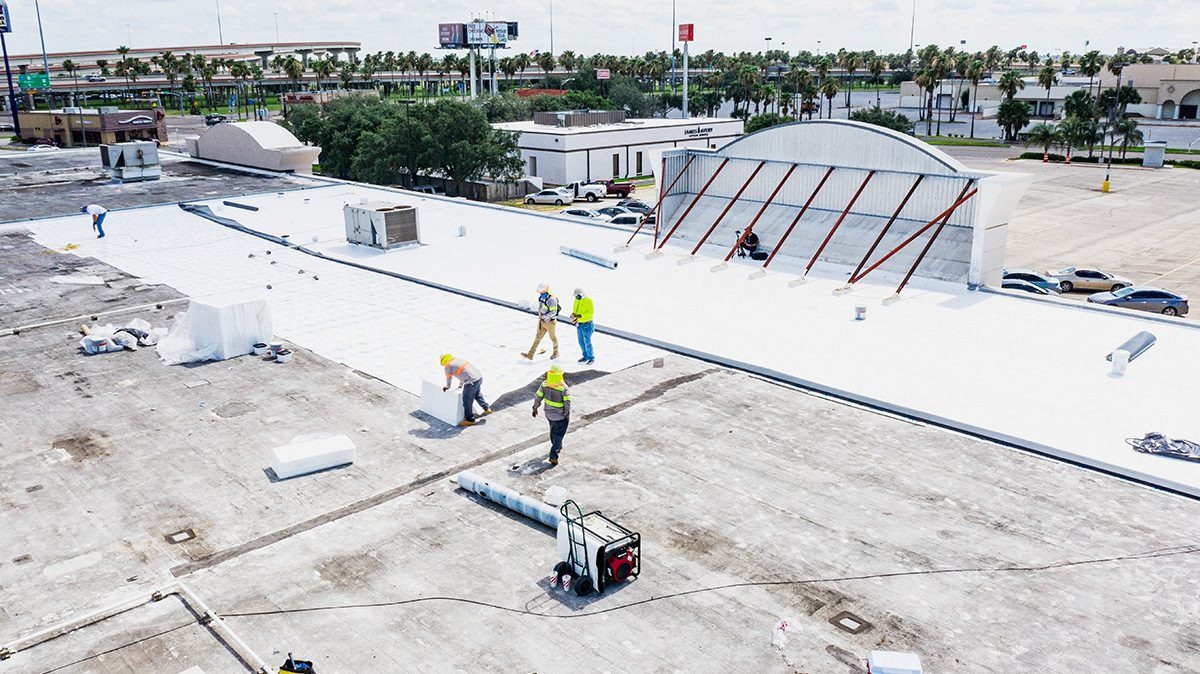
Retail Facility Roofing Minneapolis
Retail roofing in the Twin Cities runs from the Target corporate headquarters on Nicollet Mall to the Best Buy campus in Richfield to the regional strip centers and power centers across the metro. Every project has tenant operations below the roof — and that means production sequencing matters as much as membrane selection.
Target Corporation's headquarters campus stretches across several blocks of Downtown Minneapolis near Nicollet Mall. The campus includes a mix of building vintages — the older towers from the 1980s and the more recent connecting structures and annex buildings — with flat roof sections that run a variety of membrane systems. Target's facilities management team operates on an enterprise asset management platform and expects roofing contractors to deliver closeout documentation that integrates with that system. We have experience with the qualification and documentation standards that large corporate retail headquarter facilities require.
Best Buy's corporate headquarters campus in Richfield, off Highway , is one of the largest single-employer commercial roof footprints in the south metro. The campus was substantially built in the late 1990s and 2000s and is now at the decision point for recover vs. replacement on much of its flat roof inventory. Richfield's 40 psf ground snow load (Scott County adjacent, specified at 40 psf) adds a snow management dimension to every scope on this campus.
Beyond the two major HQ campuses, the Twin Cities metro has thousands of strip retail and big-box stores built between 1985 and 2015 that are entering their first or second major reroof cycle. Retailers in the Southdale corridor, the Brooklyn Park retail clusters, and the suburban strip centers across Dakota County all share a common challenge: their roofing projects have to run around tenant business hours, parking access, and the HVAC units that keep the selling floor at temperature.
Tenant Operations and Scheduling Constraints
Retail buildings have a fundamental constraint that industrial buildings do not: the roof work has to coexist with customers, employees, and deliveries running on a business-hours schedule below. We plan material staging to avoid retail parking areas, sequence crane lifts to avoid customer-access periods, and coordinate dumpster positioning with the property manager before production starts. For multi-tenant strip centers, we notify each tenant in writing before work begins and maintain a single point of contact (the property manager) for any operational concerns during production.
Big-box retail has HVAC units on the roof that cannot be shut down during business hours — the stores run air conditioning and ventilation continuously from open to close. We work around active HVAC units, maintain watertight curb flashings at every unit we work near, and do not disconnect HVAC equipment without advance coordination with the property's facilities team. Same-day dry-in on every section we open is non-negotiable on occupied retail.
Corporate Headquarters Roof Projects
Target HQ and Best Buy HQ are not standard retail roof projects. They have facilities management teams with vendor qualification processes, insurance requirements above standard commercial minimums, documented procedures for contractor access and credentialing, and asset management systems that expect specific closeout documentation formats. We work within these processes — the qualification step happens before project start, not as a surprise on day one.
Large corporate campus roofs often have complex rooftop infrastructure: satellite and communications equipment, rooftop solar arrays in some sections, generator exhaust stacks, large multi-zone HVAC systems, and in some Target and Best Buy buildings, rooftop parking decks that create additional waterproofing scope adjacent to the flat roof sections. We document rooftop infrastructure during the inspection walk and include equipment protection and relocation coordination in the pre-construction plan.
Snow load management on corporate campus roofs in the Twin Cities is a facilities-level concern, not just a roofing decision. Best Buy's Richfield campus and Target's downtown buildings both require snow removal planning as part of the maintenance program — the corporate facilities teams want defined snow depth thresholds at which they should call for removal. We include this analysis in the maintenance contract for any campus we hold on a maintenance agreement.
Strip Retail and Power Centers Across the Metro
The standard strip retail roof in the Twin Cities metro is a TPO or EPDM membrane on steel deck with polyiso insulation, typically installed between 1990 and 2010. Most of these roofs are at or past their design service life and are in the recover-vs-replace decision window. We run inspection routes on the Southdale corridor, the Brookdale and Ridgedale area retail clusters, and the Dakota County power centers, and we have condition documentation on many of these properties that property managers and REIT portfolio managers can draw on for capital planning.
Recover vs. replacement on strip retail is usually a straightforward moisture-core decision. If the insulation is dry and the deck is sound, a recover adds 15–20 years of service life at significantly lower cost than a full replacement. If the insulation is saturated — common in older strip retail where drain maintenance has been deferred — the recover option collapses and replacement is the honest scope. We pull cores on every project where the decision is not clear from visual inspection.
Can you work on retail buildings during business hours?
Yes. We schedule tear-off and noisy operations for early morning before customer-arrival hours where possible, maintain continuous dry-in over any occupied area, and run production in sections that keep active portions of the building protected. Material staging, crane positioning, and parking-area access are all coordinated with the property manager before production starts.
How do you handle rooftop HVAC units that cannot be shut down?
We work around active HVAC units with a protection plan that maintains watertight curb flashings at all times. When membrane work requires the curb flashing to be broken, we schedule that portion for off-hours windows and have a plan to restore watertight condition before the business opens. We do not leave an HVAC curb flashing open overnight.
Do you handle roofing for REIT-managed retail portfolios across multiple Twin Cities properties?
Get a roofing assessment for your retail property.
Our project managers will walk the roof, pull moisture cores if the recover-vs-replace decision requires it, and produce a written scope designed around your tenant operations and capital planning horizon.
- Manufacturing Industry Roofing
- Financial Services Roofing
- Hospitality Roofing
- Agricultural Food Roofing
- Data Center Roofing
- Single Ply Roofing
- Capital Planning Support
- Government Building Roofing