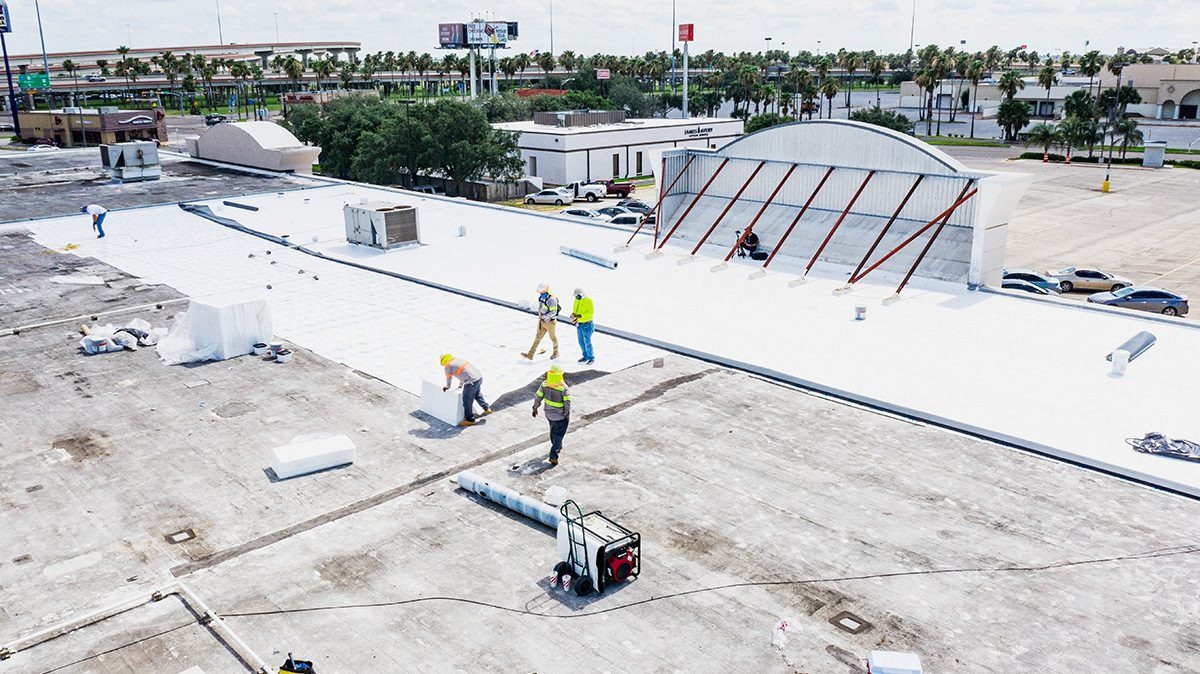
Built-Up Roof (BUR) Systems Minneapolis — Legacy Building Assessment & Replacement
Minneapolis has a meaningful inventory of 1950s through 1980s built-up roofing on its downtown towers, mid-rise commercial buildings, and North Loop warehouse stock. Most of it is at or past end of life. We inspect it, document it, and give you a written assessment — including the honest answer when replacement is the only viable scope.
Built-up roofing (BUR) — multiple plies of asphalt-saturated felt mopped together with hot asphalt or coal tar, topped with aggregate surfacing — was the standard commercial flat-roof system in Minneapolis from the early 1900s through the early 1980s. The downtown office buildings that form the core of Minneapolis's Nicollet Mall corridor, the IDS Center block, the office and mixed-use buildings along Fifth Street and Sixth Street, and the warehouse stock throughout the North Loop that was built between the 1900s and 1960s were predominantly roofed with coal-tar or asphalt BUR systems. Many of those buildings have been recovered multiple times — layers of modified bitumen cap sheet applied over the original BUR to extend waterproofing life through successive budget cycles.
That layered inventory is old. A BUR system installed in 1965 on a downtown Minneapolis building is now 60 years old. Even the youngest BUR systems from the early 1980s are over 40 years old. Eventually the recovery path runs out: the deck cannot support additional load given Minnesota snow load requirements, the flashing geometry at the top of multiple recovery cycles cannot be reliably detailed for another freeze-thaw season, and the total roof assembly has to come off. Minneapolis's 35-psf ground snow load design requirement adds urgency to this calculation — a collapsed, saturated insulation stack under a multi-layer BUR/mod-bit recovery is a structural liability under a snow event, not just a waterproofing deficiency.
We do not install new BUR systems. We assess, document, and replace them. If you own or manage a Minneapolis or Twin Cities metro building with original BUR or a multi-layer BUR/mod-bit recovered system, we will tell you where it stands in its lifecycle and what the replacement scope looks like — with honest assessment of the deck condition findings that most matter in the cold-climate replacement decision.
Coal-Tar vs Asphalt BUR — What's on Your Minneapolis Building
Minneapolis BUR systems from the 1950s through 1970s were built with either coal-tar pitch or oxidized asphalt (Type III or IV). Coal-tar BUR is chemically more durable and has genuine self-healing properties for minor surface cracks — the Nicollet Mall-area office buildings that have been on coal-tar BUR since the 1960s and are still marginally watertight are not unusual findings in our inspection experience. The challenge with coal-tar in Minnesota is that freeze-thaw cycling eventually opens the self-healed cracks faster than they close, and coal-tar removal requires special handling protocols and disposal costs that add meaningfully to project budgets.
Asphalt BUR from the same era shows more pronounced alligatoring and surface cracking, particularly on south and west roof zones that take the most UV exposure over a Minneapolis summer. Asphalt-based felt plies from pre-1980 construction frequently contain chrysotile asbestos — Minnesota Statute 326B and MPCA regulations require an asbestos survey by a licensed consultant before any work that disturbs asbestos-containing roofing materials. We do not remove BUR materials without a completed and documented asbestos assessment on buildings constructed before 1980.
When Full Replacement Is the Only Honest Scope
We get asked whether a BUR system can be recovered rather than replaced on every aging building inspection we conduct. Sometimes the answer is yes: if the existing insulation is dry on core pulls, the deck is sound under the wet-area inspection ports we open, and the BUR surface is stable enough to support a new mechanically attached single-ply system, a recover can be viable and significantly less expensive than full tear-off and replacement.
The Minnesota conditions that most often make full replacement the correct scope: wet insulation in more than 25% of cores, which in a Minneapolis building means R-value collapse and structural load amplification under snow events; deck corrosion or rot under wet areas requiring deck replacement, which means the BUR assembly has to come off anyway; and parapet flashings that have accumulated so many recovery layers that the flashing termination bar is at or above the parapet cap and cannot accommodate a new flashing detail with adequate height for Minnesota snow depth clearance. We document these findings before the contract is signed, not during demolition.
Replacement Scope for Minneapolis BUR Buildings
BUR removal from a downtown Minneapolis building involves permits with the City of Minneapolis Building Inspection division, asbestos survey for pre-1980 buildings, coal-tar disposal protocol if applicable, and crane and staging coordination in areas where downtown Minneapolis street access is constrained by the Nicollet Transit Mall vehicle restrictions and skyway-level pedestrian flows. We have managed these logistics on downtown Minneapolis BUR projects and know the permit requirements and staging constraints specific to the core.
After removal, the new system is typically TPO or EPDM over new polyiso insulation to Minnesota energy code R-30 minimum, with tapered insulation packages that improve drainage toward interior drains and reduce ice dam risk at parapet walls. We close out with a manufacturer NDL warranty and a complete documented roof asset file — so the building owner has a full record from bare deck forward that supports capital planning, lender documentation, and future warranty management.
Does my pre-1980 Minneapolis building need an asbestos survey before BUR removal?
Yes, under Minnesota regulations and the MPCA's asbestos rules. Asphalt felts manufactured before approximately 1980 frequently contained chrysotile asbestos as a reinforcing and stabilizing agent. Minnesota Statute 326B requires an asbestos survey by a licensed asbestos inspector before any demolition or renovation that disturbs roofing materials on pre-1980 buildings. We do not begin removal work without a completed survey and documented abatement plan if asbestos-containing materials are present. We can provide referrals to licensed asbestos consultants we have worked with on downtown Minneapolis projects.
Can a built-up roof be recovered instead of replaced in Minneapolis?
Yes, if the conditions support it. We pull five to ten moisture cores, inspect the deck at core locations, and assess the surface and parapet flashing condition. If insulation is dry, the deck is sound, and the parapet flashing geometry can accommodate a new detail with adequate height above design snow depth, a mechanically attached TPO or EPDM recover over the existing BUR is often a viable 15 to 20 year extension at meaningfully less cost than full tear-off and replacement. We give you the core data and costs for both options in writing before you decide.
How do you handle BUR removal on occupied downtown Minneapolis buildings?
Staged tear-off in 5,000 to 10,000 square foot sections maximum with same-day dry-in on each open section. No section left open overnight, and weather holds stop production whenever the National Weather Service forecast shows precipitation risk within the open-section window. Coal-tar removal on occupied buildings requires negative-air systems at the closest roof penetration to occupied space to control odor infiltration. We coordinate daily work windows with the building's facility manager to protect tenant operations during production.
- Spray Polyurethane Foam Systems
- Cool Roof Systems
- Ballasted Roof Systems
- TPO Roof Systems
- EPDM Roof Systems
- Auto Dealership Roofing
- Preventive Roof Maintenance
- Parapet Wall Repair