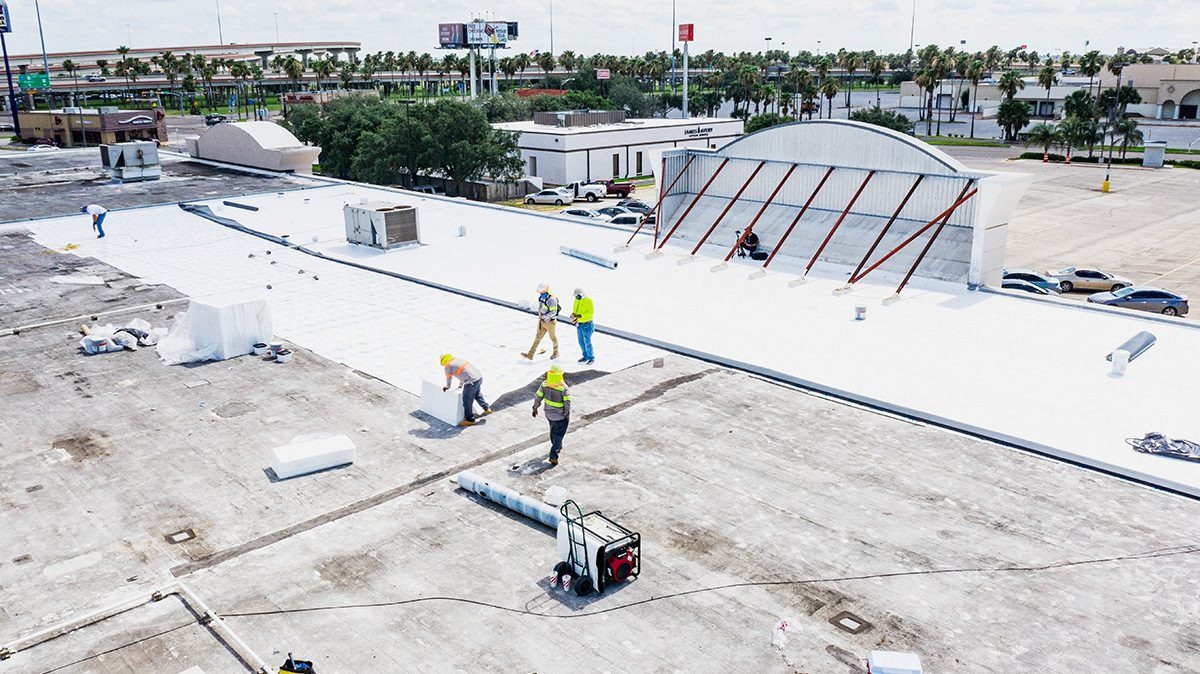
Roof Recover Systems in Minneapolis, MN
A roof recover installs a new membrane and insulation over the existing system without tear-off — reducing project cost by 20–35% and eliminating the tear-off waste and weather-exposure risk that full replacement creates on a Minneapolis winter schedule.
Recover is not the right answer for every Minneapolis commercial roof, and it is not a shortcut to avoid making a proper recover-versus-replace decision. The recover decision requires moisture core sampling to confirm the existing insulation is dry, a deck inspection to confirm the structural system can support the added dead load of a second roof assembly, and a building code analysis to confirm that a second recover is not prohibited (most codes limit commercial roofs to two roof systems before requiring full tear-off to the deck).
When the conditions support it — and on the large portion of Minneapolis's commercial roof inventory where they do — recover is the right capital decision. The Twin Cities metro has an enormous stock of late-1980s and 1990s commercial buildings with single-ply TPO and EPDM systems that are now approaching the 25-30 year mark. Many of those buildings have dry insulation, sound decks, and systems that have not been previously recovered. Those buildings are prime recover candidates: a new TPO or modified bitumen cap system over the existing membrane, with added polyiso insulation to reach current Minnesota energy code minimums, extends the service life by 15–20 years at roughly 65–75% of full replacement cost.
We have completed roof recover projects on warehouse and flex buildings along the I-494 industrial corridor in Brooklyn Park, on medical office buildings in the Midtown Minneapolis area near Abbott Northwestern, and on retail centers in the southwest metro suburbs where the building owners needed to extend service life to align with lease cycles. The recover approach eliminated the weather exposure of a full tear-off sequence and, in several cases, allowed the building to remain fully occupied during production.
Recover Eligibility Assessment for Minneapolis Buildings
Moisture core sampling is the non-negotiable first step. We pull cores in a representative grid — at minimum, five to ten locations per 50,000 sq ft of roof area, with additional cores at drains, parapets, and areas of visible surface distress. Core samples are inspected immediately on-site for moisture presence and sent to a testing lab for confirmation on ambiguous samples. If wet insulation is present in more than 25% of core locations, recover is not the right answer — the wet insulation has to come out regardless, and at that saturation level, replacement economics close the gap with recover.
Dead load capacity review is the second step. The existing roof assembly has a dead load (membrane, insulation, substrate, ballast if present). The recover system adds another dead load: typically R-15 to R-20 polyiso (approximately 2–3 inches) plus a new membrane. We calculate the combined dead load against the structural design load per the building's original structural drawings. On older Minneapolis buildings — particularly the 1970s and 1980s warehouse and office stock in Northeast Minneapolis and the Warehouse District — original structural drawings are not always available. In those cases, we engage a structural engineer to assess dead load capacity before the recover scope is finalized.
Existing roof count is the third consideration. Minnesota State Building Code and most municipal amendments limit commercial buildings to two roof systems before full tear-off is required. We document the existing roof assembly count during core sampling — the core cross-section reveals how many layers are present. A building that has already been recovered once, with two systems in place, cannot be recovered again without tear-off. We identify this condition before the owner makes a capital decision based on recover economics.
Recover System Specifications for Minneapolis Climate
TPO over existing TPO or EPDM is the most common recover system on Minneapolis commercial buildings. The new TPO sheet is mechanically attached through the existing membrane and insulation to the structural deck, providing an anchored system that resists Minnesota wind uplift loads without relying on adhesion to the existing surface. Mechanically attached TPO over recover insulation is FM 1-90 rated for wind uplift — the performance level that most Minneapolis commercial leases and lender requirements specify.
Modified bitumen SBS recover over existing BUR is the appropriate choice for buildings where the owner wants to maintain a heavier, multi-layer system for redundancy. The SBS polymer gives the modified bitumen membrane the low-temperature flexibility that standard APP bitumen lacks in Minnesota winters — SBS remains flexible to -20°F, which is within the range of a hard Minneapolis cold snap. Torch-applied modified bitumen recover over existing BUR is a common scope on North Loop warehouse buildings where the original 1990s BUR system has surface degradation but sound insulation.
Insulation specification for Minneapolis recover systems must account for Minnesota energy code requirements. The existing insulation, if dry and intact, contributes to the total R-value of the assembly. We calculate the existing R-value (tested after the cores are pulled) and specify recover insulation to bring the total assembly to current code minimums (R-30 for low-slope commercial under the current Minnesota State Energy Code). Polyiso recover board is the standard choice — high R-value per inch allows the added insulation layer to stay thin enough to clear parapet heights and avoid reworking through-wall flashing at every penetration.
Managing Recover Projects on Occupied Minneapolis Buildings
Recover eliminates the weather-exposure risk of full tear-off, which is a significant advantage on Minneapolis commercial buildings where an open deck in November is a liability. The existing membrane stays in place throughout the project as a secondary waterproofing layer — if a Minneapolis afternoon thunderstorm moves in faster than the forecast indicated, the building below is protected by the existing membrane while the recover crew covers the open insulation with tarps.
Noise and vibration from mechanical fastening penetrate into the building below — a real concern for the medical office tenants near Midtown Minneapolis or the corporate campus occupants in the Golden Valley and Plymouth corridors. We coordinate the production schedule with building management to move mechanical fastening work to hours when it causes least disruption, and we document the fastening grid before starting to confirm the crew can complete each day's work area within the agreed time window.
Drain management during recover requires raising the drain to the new surface elevation — the recover insulation and membrane raise the roof surface by 2–4 inches depending on the insulation specification. We replace drain inserts and clamping rings with new components sized for the new assembly depth, and we document the drain elevation changes in the closeout package so that future maintenance crews understand the current assembly configuration.
How much does a roof recover cost compared to full replacement in Minneapolis?
Recover typically runs 65–75% of full replacement cost for equivalent membrane and insulation specifications. The savings come from eliminating tear-off labor and disposal — tear-off on a 50,000 sq ft Minneapolis commercial roof generates 80–120 tons of debris that requires disposal at Hennepin County-permitted facilities, plus the labor to load it. The recover cost gap narrows when there are significant areas of wet insulation that must be cut out before recovering, when the existing drainage configuration requires significant rework, or when drain replacement costs are elevated due to the number of drains in the system.
Will a recover system qualify for a manufacturer warranty?
Yes — major TPO and modified bitumen manufacturers offer warranty programs for recover installations that The warranty term for a recover system is typically the same as for a new installation: 15–25 years depending on the manufacturer and the specific warranty program selected. We coordinate the manufacturer's field inspection at closeout as part of the warranty process.
How long does a recover project take on a Minneapolis commercial building?
For a 50,000 sq ft single-story building with no deck replacement and wet-area remediation of less than 10% of the area: 2–3 weeks of production in summer conditions. The recover sequence is faster than full replacement because there is no tear-off phase — we go directly from wet-area cut-out and insulation installation to membrane installation. Winter recover projects add 15–20% production time for weather holds and substrate preparation requirements.
Find out if your Minneapolis commercial roof qualifies for recover.
Our project managers will pull moisture cores, assess dead load capacity, and give you a written recover-versus-replace analysis — with the data that supports whichever direction the building's condition dictates.
- Snow Load Roof Design
- Roof Inspections
- Built Up Roofing
- School Roofing
- University Campus Roofing
- Emergency Roof Repair
- Restaurant Roofing
- About