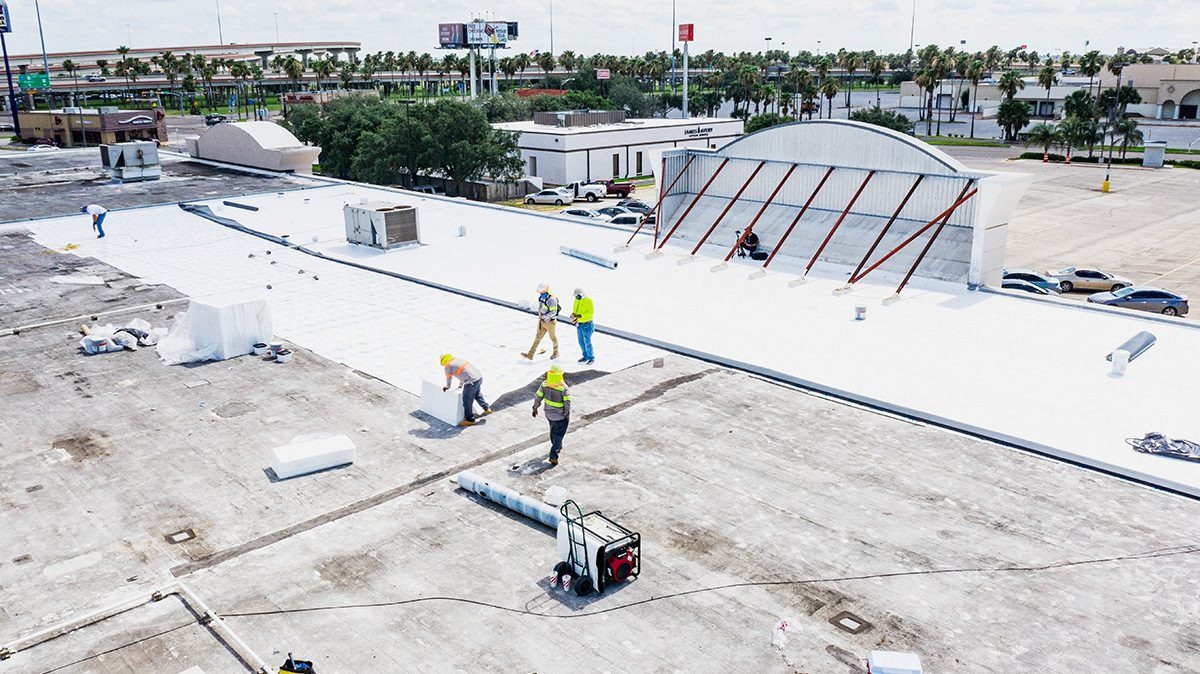
PVC Commercial Roofing in Minneapolis, MN
PVC's heat-welded seam technology produces the strongest seam in the single-ply membrane market — and on a Minneapolis commercial roof that cycles from -25°F to 95°F+ every year, seam integrity is the decisive specification criteria.
PVC — polyvinyl chloride — is the premium single-ply membrane for commercial buildings where chemical resistance, heat-welded seam strength, and reflective roofing performance are the primary specification requirements. In the Twin Cities commercial market, PVC is specified most often on restaurant buildings and food processing facilities (PVC resists fat and grease that degrade standard TPO membranes), on buildings with rooftop HVAC exhaust near the membrane field, and on new construction where the building envelope team wants the lowest-permeability, highest-seam-strength option in the single-ply category.
PVC's thermal performance is relevant in the Minneapolis climate. The reflective white surface of a standard PVC membrane reduces summer cooling load — on a Downtown Minneapolis office building near the Nicollet Mall corridor, the surface temperature difference between a black EPDM membrane and a white PVC membrane on the same July afternoon can be 50 to 70°F. That thermal load reduction translates directly to HVAC runtime and energy cost. When we are specifying for a building that also runs high rooftop mechanical loads — the Eden Prairie UnitedHealth campus, the Target HQ buildings in Brooklyn Park, or the large corporate campuses that have extensive rooftop infrastructure — PVC reflectivity is part of the total-cost-of-ownership calculation.
The specification concern with PVC in the Twin Cities climate is cold-temperature flexibility. PVC becomes less flexible at low temperatures than EPDM or the latest generation of TPO, and original PVC membranes from the 1980s and early 1990s can develop cold-crack failure at seams during extreme cold events — Minneapolis does record -25°F ambient temperatures during severe polar vortex events. Current-generation PVC membranes from major manufacturers include plasticizer packages that maintain adequate flexibility to -40°F, but the specification has to select for cold-weather performance, not just standard commercial.
Where PVC Is the Right Specification
Restaurant and food service buildings: Grease exhaust from commercial kitchen ventilation degrades TPO membranes over time — the petroleum-based plasticizers in TPO are attacked by cooking grease, producing membrane swelling and seam failure at kitchen exhaust discharge areas. PVC is inherently resistant to animal fats and vegetable oils and is the standard specification for membrane areas that receive restaurant exhaust. The restaurant and food service inventory across the Uptown corridor, Nicollet Mall food and beverage ground-floor tenants, and the North Loop restaurant district benefits from PVC specification on kitchen-exhaust-adjacent membrane areas.
Chemical processing and industrial: 3M's Maplewood campus, industrial buildings in the Northeast Minneapolis manufacturing corridor, and the light industrial inventory in Brooklyn Park include buildings where solvent and chemical exhaust contacts the roof membrane. PVC's chemical resistance profile is broader than TPO or EPDM for most common industrial chemicals. We specify membrane area and system based on the specific chemicals present — not all chemicals are benign to PVC either, and the chemical compatibility review is part of our specification process for industrial buildings.
High-specification new construction: On new commercial construction where the building envelope consultant has specified PVC for its seam integrity and thermal performance combination — such as Class A office construction in the Downtown core or new corporate campus construction along the Eden Prairie tech corridor — we install PVC per the design specifications using manufacturer-approved heat-welded seam protocols.
Recover over existing PVC: PVC-over-PVC recover is a straightforward system that allows the heat-welded seam technology to bond to the existing membrane substrate. We have completed PVC recovers on Uptown mixed-use buildings and on commercial buildings in the Edina Southdale corridor where the original PVC system has passed its warranty period but the substrate is still sound and dry.
PVC Seam Technology in Minnesota Conditions
Heat-welded seams on PVC and TPO membranes are produced by a hot-air welding gun that fuses the two membrane surfaces into a continuous bond across the full lap width. The seam is tested with a probing tool — a seam probe is drawn along the seam edge and any area that separates is re-welded before the seam is accepted. This is a fundamentally stronger connection than the adhesive-based seam used on EPDM, and it is why heat-welded single-ply systems (TPO and PVC) have largely replaced EPDM in new commercial roofing installation over the past 15 years.
Cold-weather welding in Minneapolis requires heat-welded work to be performed with welding equipment that maintains seam temperatures despite ambient air temperatures well below freezing. We use welding guns rated for cold-weather operation and verify seam quality with the probe tool on every seam run — cold-weather welds require adjusted speed and temperature settings, and seam quality inspection is more rigorous in cold conditions because visual inspection is less reliable at low temperatures.
Winter PVC repair: PVC membranes at very low temperatures become less flexible and more brittle than EPDM. Emergency repairs on PVC roofs during Minneapolis polar vortex events — when temperatures drop below -20°F — require careful membrane handling to avoid cracking the existing membrane during repair operations. We use flexible patching protocols in cold weather and schedule full-scale PVC seam work for conditions above 20°F where membrane handling is practical.
PVC vs. TPO in the Minneapolis Market
TPO has largely displaced PVC in the general commercial market over the past decade — lower installed cost, adequate cold-temperature flexibility, and the same reflective white surface. PVC maintains a meaningful market share in applications where chemical resistance is required, where the building's specification calls explicitly for PVC, or where the design team has a performance requirement that current-generation TPO does not meet.
On a cost-per-square-foot basis, PVC typically runs 10 to 20 percent above TPO in the Twin Cities market. That premium is justified in chemical-resistant applications and where the owner has a long-term hold strategy and is buying for 30-year performance rather than the initial cost. For general commercial installation where chemical resistance is not a factor, TPO is usually the appropriate specification — we recommend PVC where it is the right system, not as a default premium upgrade.
Why is PVC specified for restaurant buildings in Minneapolis?
Cooking grease from commercial kitchen exhaust attacks the plasticizers in TPO membranes, causing swelling and seam failure at areas of exhaust discharge. PVC is chemically resistant to animal fats and vegetable oils and does not degrade under routine kitchen exhaust exposure. On mixed-use buildings in Uptown and Nicollet Mall-area retail where restaurant tenants share the roof with office tenants, we specify PVC in the kitchen-exhaust zone and TPO in the rest of the field — the systems heat-weld together at the transition detail.
Does PVC crack in Minneapolis winters?
First-generation PVC from the 1980s and early 1990s can develop cold-crack failure because the original plasticizer packages were not formulated for extreme cold. Current-generation PVC membranes from major manufacturers (Sarnafil, Duro-Last, Firestone) include advanced plasticizer systems that maintain adequate flexibility to -40°F — well below Minneapolis's recorded extreme lows. We specify current-generation products and verify the manufacturer's cold-temperature flexibility rating before writing any PVC specification for a Twin Cities building.
How do you handle PVC inspection for buildings on the UnitedHealth or Target campus portfolios?
Large corporate campus buildings with sophisticated facilities management teams require inspection documentation in specific formats — we can produce inspection reports compatible with the asset management systems used by major corporate facilities organizations. We have experience with the documentation and coordination requirements of large portfolio buildings and can provide inspection and maintenance services that integrate with the building owner's existing facilities management program.
PVC roofing scope for your Minneapolis commercial building.
Our project managers will assess whether PVC is the right system specification for your building type and location, scope the installation or recover, and provide manufacturer warranty documentation through closeout.
- Restaurant Roofing
- Solar Roof Integration
- Commercial Roof Maintenance
- Drain Cleaning Repair
- Condition Reporting
- University Campus Roofing
- Roof Replacement Planning
- About