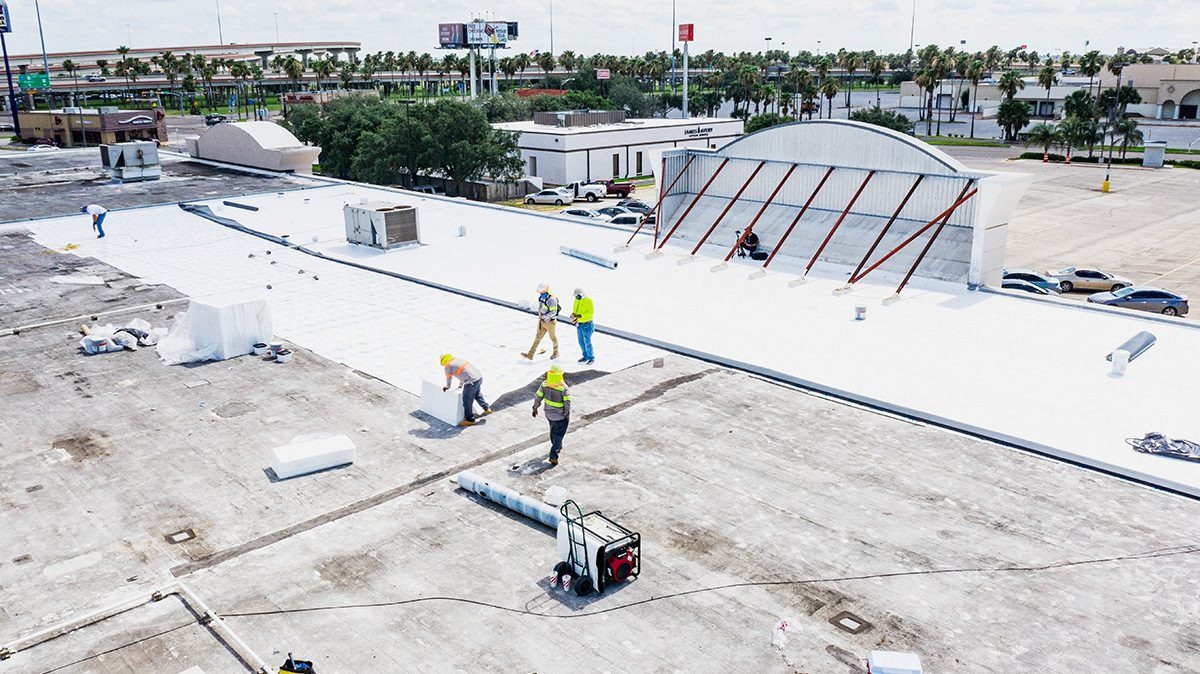
Office Building Roofing in Minneapolis, MN
Commercial roofing for Class A, B, and C office buildings, suburban office parks, and downtown towers throughout Minneapolis, MN.
Target Corporation's corporate headquarters in the heart of downtown Minneapolis represents the pinnacle of Class A office building standards in the Upper Midwest. Target's campus—a complex of interconnected towers and low-rise buildings bridging multiple city blocks—demands a roofing management approach that combines the technical precision of cold-climate membrane work with the operational sophistication of occupied corporate campus coordination. Minneapolis's office market, which extends from downtown through the Uptown and Midtown corridors into the suburban campus developments of Eden Prairie and Plymouth, operates in the harshest cold-climate office roofing environment of any major US metropolitan area.
Occupied building protocols in Minneapolis have a distinct cold-climate character. Work stops completely when temperatures drop below the installation thresholds for the specified membrane—a common occurrence from November through March. But unlike other markets where a weather hold is inconvenient, a Minneapolis weather hold during a partially open building in January is a crisis if the building is not properly protected. Emergency weather response protocols must be tested, not just written. A roofing contractor who has managed cold-weather holds on occupied Minneapolis corporate campus projects has developed these protocols through real-world experience. Insist on interviewing the specific project manager who will run the job, not just reviewing the company's written procedures.
HVAC coordination in Minneapolis office buildings must account for the year-round criticality of HVAC service. Summer cooling is important, but winter heating in Minneapolis is life-safety critical—a failed heating system in a January cold snap is not an inconvenience, it is an emergency. HVAC curb re-flashing on Target's campus or any major Minneapolis corporate building requires the most careful possible scheduling and the shortest possible shutdown windows. The optimal window for HVAC curb work in Minneapolis is May through September, when outdoor temperatures are moderate and brief shutdowns are tolerable. Any fall or winter HVAC work is a last resort requiring detailed contingency planning.
Green roof options in Minneapolis have attracted strong institutional support. Target's own sustainability commitments, the City of Minneapolis's stormwater management program, and the Minneapolis Metropolitan Council's clean water initiative all create positive context for green roof installation. The city's stormwater utility credit program for qualifying on-site retention generates annual financial value for buildings with green roof installations, and a large corporate campus can capture significant annual credits. Cold-climate green roof specifications in Minneapolis must use plant species that survive -30°F winters without heated growing media—native Minnesota prairie species, particularly sedums and cold-hardy grasses, are the established specification.
Minnesota energy code requirements for Minneapolis office building roofing are among the most demanding in the country. ASHRAE 90.1 Climate Zone 6A requires R-30 minimum for low-slope commercial assemblies, and Minneapolis's approximately 9,000 annual heating degree days—among the highest of any major US metro—make the insulation specification the most impactful energy decision in the roofing project. Target's campus and other Minneapolis Class A corporate buildings typically target R-35 to R-40 to maximize heating cost reduction. Xcel Energy offers commercial energy efficiency programs that have included qualifying roof assembly insulation upgrades, and building owners should verify current program availability before finalizing specifications.
Lease obligations for multi-tenant Minneapolis office buildings are governed by Minnesota commercial landlord-tenant law and the specific provisions of each tenant's lease. Minnesota courts have consistently enforced quiet enjoyment provisions in commercial leases, and building owners who proceed with disruptive construction work without proper tenant notification face real legal exposure. Before scheduling re-roofing on a multi-tenant Minneapolis office building, a complete lease audit by Minnesota real estate counsel is the appropriate first step. Single-tenant corporate campuses like Target's have simpler coordination requirements but more sophisticated facilities management oversight that requires equally careful pre-project communication.
Historic buildings in Minneapolis's downtown office market—including several early-20th-century office towers in the Nicollet Mall corridor—require roofing contractors with historic preservation experience. Minnesota's Historic Preservation Office administers the state's Section 106 process, and alterations to listed properties require review. The Minneapolis Heritage Preservation Commission has jurisdiction over locally designated historic districts. A roofing contractor working on a historic Minneapolis office building must understand the documentation requirements and approval processes before beginning any work that affects visible historic elements.
Snow and ice management on Minneapolis office building rooftops is an operational challenge that extends through the entire November-through-April period. Parapet walls accumulate drifted snow that can create ice dams when melt cycles occur. Heated rooftop walkway cables, heated drain bowls, and electrically traced drain lines are standard features on well-maintained Minneapolis Class A office buildings. Buildings that lack these features should prioritize adding them as part of re-roofing projects. The cost of a blocked drain or ice dam water intrusion event in a Class A occupied office building far exceeds the cost of the heating system that prevents it.
Cost benchmarks for Minneapolis Class A office building roofing are among the highest non-coastal costs in the US series. Cold-climate EPDM or TPO re-roofing projects with R-35 polyiso run $15–$22 per square foot. Complex multi-building corporate campus work with significant HVAC coordination runs $20–$28 per square foot. Green roof semi-intensive additions with Minnesota native cold-hardy plantings run $23–$35 per square foot. Xcel Energy qualifying insulation upgrade rebates offset $0.10–$0.25 per square foot. Minneapolis stormwater utility credits for qualifying green roofs represent ongoing annual value that should be calculated and included in project ROI analysis.
How do I know if my Minneapolis BUR roof needs repair or full replacement?
The decision turns on moisture saturation in the insulation layer. If core sampling shows wet insulation in more than 25% of the roof area, replacement is typically more cost-effective than recover — saturated insulation has to be removed regardless, and at that percentage the removal and disposal cost closes the gap between recover and replacement. If wet areas are under 25%, we cut out the wet insulation, replace it, and recover the system. We document every core pull and give you the data to make the decision — we do not make a replace recommendation on surface condition alone.
Can you work on BUR roofs in Minneapolis winters?
Repair and maintenance work on BUR systems can be done in winter with appropriate materials — modified bitumen torch patches, cold-applied sheet materials rated for cold-temperature application, and peel-and-stick flashing products that maintain bond at low temperatures. Hot-mop BUR installation (new multi-ply systems installed with a kettle and hot bitumen) requires substrate temperatures above the minimum specified by the bitumen manufacturer — typically 40°F for the substrate, not ambient — which limits full-system installation to the warmer months. Emergency dry-in work in winter uses temporary materials that are replaced when conditions allow.
Does working on an existing BUR system require special disposal procedures?
Older BUR systems — particularly those installed before 1975 — may contain asbestos-containing materials in the ply felts or the bitumen compound. We require an asbestos survey prior to any core sampling or tear-off on BUR systems that predate 1975. The survey is the building owner's responsibility, but we can coordinate with qualified industrial hygienists in the Minneapolis market. Asbestos-containing BUR systems require abatement by a licensed asbestos contractor before roofing work proceeds — this adds time and cost to the project scope and needs to be in the project plan before contract signing.
Get a BUR assessment for your Minneapolis commercial building.
Our project managers will inspect the system, pull moisture cores at suspect locations, document the condition, and give you a written report that separates repair from recover from replacement — with the data to back it up.
- Commercial Roof Coatings
- Roof Leak Repair
- Roof Replacement Planning
- Auto Dealership Roofing
- Government Building Roofing
- EPDM Roofing
- Retail Roofing
- About