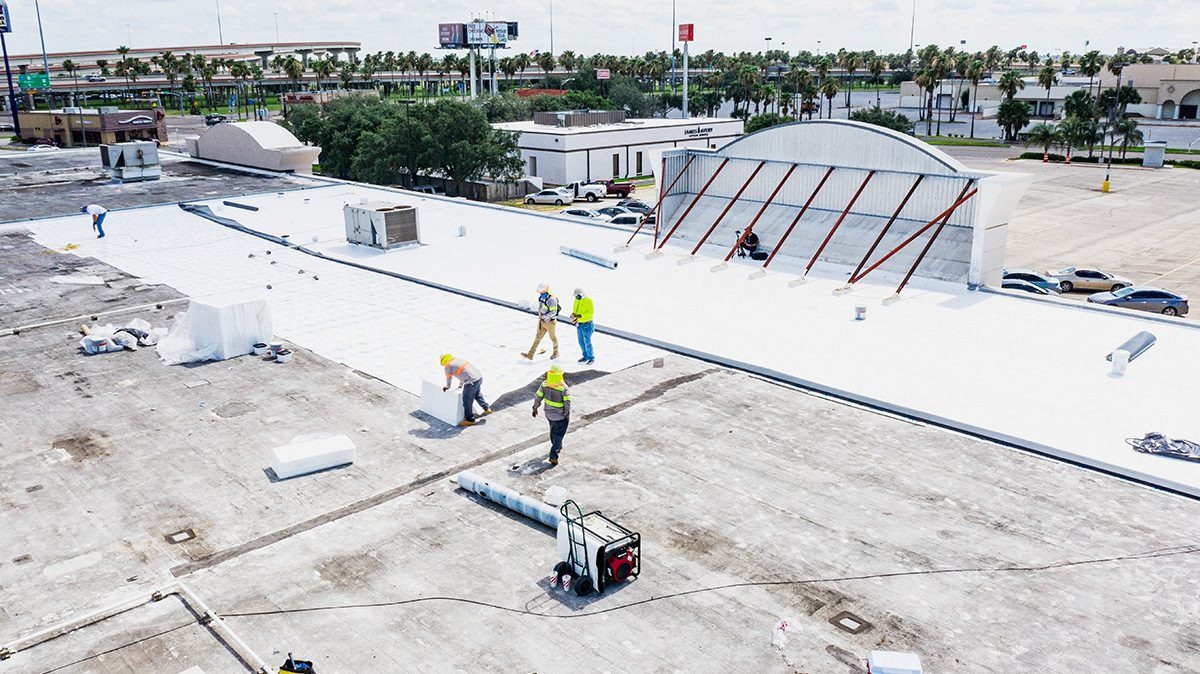
Modified Bitumen Commercial Roofing in Minneapolis, MN
Modified bitumen's SBS polymer system gives the membrane cold-temperature flexibility that standard asphalt bitumen lacks — and on a Minneapolis commercial roof that sees -25°F winters and 40+ psf blizzard loads, that flexibility matters more than in any warm-climate market.
Modified bitumen roofing is what replaced built-up roofing (BUR) on most Minneapolis commercial buildings in the 1980s and 1990s — and it is what currently accounts for a large portion of the commercial roof stock that is now reaching its design life across the Twin Cities metro. The North Loop warehouse conversions that went on modified bitumen in 1988, the first-wave Uptown mixed-use buildings that were recovered with modified bitumen in 1995, and the suburban retail corridor buildings from the same era are all in the active replacement or major-repair cycle.
Two types of modified bitumen are in the Twin Cities commercial inventory: SBS (styrene-butadiene-styrene) and APP (atactic polypropylene). The distinction matters in Minnesota. SBS-modified membranes retain cold-temperature flexibility — SBS polymer keeps the bitumen matrix rubbery at temperatures far below zero — and are the appropriate specification for Minneapolis buildings where the membrane will be stressed during polar vortex events. APP-modified membranes, which are harder and more suited to torch-application, are more brittle at extreme cold and are more prone to crack failure during the freeze events that Minneapolis records every few years. We specify SBS for new installation and major recover work in the Twin Cities, and we assess the existing membrane type when repairing aging buildings.
Our modified bitumen work includes torch-applied installation for standard conditions, cold-applied systems for buildings where open-flame hot work is restricted (hospitals near the U of M medical campus, occupied high-rise buildings in the Downtown core, and buildings with sensitive interior uses), and repair service using SBS patch material that stays flexible in emergency repair situations at -20°F ambient.
Modified Bitumen Installation Methods
Torch-applied SBS (two-ply): The standard installation for most Twin Cities commercial buildings. A base sheet is mechanically fastened to the deck or adhered to the insulation; the SBS cap sheet is torch-applied to the base sheet with lap seams heat-fused by the torch. The resulting membrane is 3 to 4 mm thick with a fully-bonded lap seam — more resistant to wind uplift than mechanically-attached single-ply. Torch-applied work requires a fire watch protocol and hot-work permits on occupied buildings; we manage the permit process and fire watch as a standard component of every torch-applied project.
Cold-applied SBS: Used on buildings where open-flame work is restricted or where the building is occupied and the fire risk of torch application is unacceptable. Cold-applied systems use either solvent-based or water-based adhesive to bond the cap sheet — the seam quality is adequate for most commercial applications, though not as thermally fused as torch application. We use cold-applied systems on the occupied healthcare and research buildings adjacent to the U of M medical campus and on Downtown office towers where hot-work permits involve building-wide fire alarm coordination.
Modified bitumen recover: Installing a new SBS cap sheet over an existing modified bitumen base is a viable recover strategy when the existing base sheet is dry (confirmed by moisture cores), dimensionally stable, and has adequate adhesion to the substrate. Modified bitumen recover avoids the tear-off cost and the structural exposure of a full replacement, and is often the right scope for the first recover cycle on a well-maintained building. We have completed modified bitumen recovers on aging Northeast Minneapolis industrial buildings and on suburban retail buildings in the Edina Southdale and Bloomington corridors.
Modified Bitumen Performance in Minnesota Conditions
Modified bitumen is one of the most proven membrane systems in cold climates. Unlike TPO or EPDM, which are sheet membranes with adhesive or heat-welded seams, modified bitumen is a built-up system where the lap seams are bonded by the same asphalt matrix that forms the field membrane — there is no separate adhesive that can fail independently of the membrane. In a climate with 30 to 50 freeze-thaw cycles per year, that material continuity at the seam is a performance advantage.
The failure modes on aging Minneapolis modified bitumen systems are consistent: surface granule loss and bitumen oxidation on APP membranes that have reached the end of their flexibility range, blistering from trapped moisture vapor that could not escape through the system during the hot summer months, and parapet flashing delamination from ice jacking at the wall-to-membrane transition. We assess each of these failure modes during inspection and distinguish between surface degradation that responds to coating or cap sheet recover and substrate failure that requires tear-off and replacement.
Thermal shock at -25°F: The polar vortex events that periodically push Minneapolis temperatures to record lows — the January 2019 event recorded -28°F at MSP, and the February 2021 cold snap reached -20°F — put extreme stress on any membrane system. SBS-modified bitumen is specifically engineered to retain flexibility at temperatures far below those events. We specify SBS for all new work and repairs in the Twin Cities — APP is not an appropriate specification for a climate with documented extreme cold events.
Modified Bitumen Repair Across Minneapolis
Emergency SBS repair is one of the most field-practical operations in commercial roofing. SBS patch material can be torch-applied at temperatures well below zero — a repair crew can dry-in an active leak during a January cold event using torch-applied SBS when other membrane systems require minimum-temperature adhesives. This is why our emergency service trucks carry SBS material year-round regardless of what system is on the building: an interim SBS patch is often the fastest path to stopping interior water entry during a Minneapolis winter emergency.
On the North Loop warehouse buildings and the Northeast Minneapolis industrial conversions, we are regularly repairing roofs that have had multiple prior modified bitumen repair layers accumulated over 30 to 40 years. Each repair layer adds weight and can trap moisture between layers. Before we add another repair layer, we core the existing system to assess whether the accumulated repairs have produced a system that is too heavy, too wet, or too complex to repair cost-effectively. Sometimes the honest scope is to stop repairing and start planning the replacement — and that is what we tell building owners, in writing, with the data behind it.
Is modified bitumen or TPO better for Minneapolis commercial roofs?
It depends on the building. Modified bitumen has a longer track record in cold climates, better field-repair options in extreme cold, and is the stronger choice for low-slope roofs with complex drainage conditions. TPO has lower installed cost, better reflectivity for energy performance, and is the dominant specification for new commercial construction across the Twin Cities. For existing modified bitumen buildings, a compatible modify bitumen recover is often the right first re-roof cycle before moving to a single-ply system in the second cycle.
Can modified bitumen be installed in a Minneapolis winter?
Torch-applied SBS can be installed in cold weather with attention to substrate preparation — frost removal, surface drying, and preheating of the base sheet before torch application. We have installed SBS in January conditions at -5°F ambient on buildings where production schedule required it. Cold-weather installation takes longer and requires more careful quality control than summer work, which is reflected in the project schedule and budget. We do not install in active precipitation or on ice-covered substrates.
How do I know if my modified bitumen roof needs recover or replacement?
The key diagnostic is moisture core results and deck condition. If moisture cores show less than 20% of the roof area with saturated insulation and the deck is structurally sound, recover is usually the cost-effective scope. If cores show widespread saturation, if the deck has structural deterioration from decades of ice dam infiltration, or if the parapet wall condition does not support the flashing detail required for a long-term recover, replacement is the honest recommendation. We pull the cores, inspect the deck, and document the findings — the recover-vs-replace recommendation comes with the data, not just the opinion.
Modified bitumen assessment for your Minneapolis building.
Our project managers will walk the roof, pull moisture cores, assess deck condition, and deliver a written scope that tells you whether you are looking at a repair, recover, or replacement — with the documentation to support whichever decision you make.
- Mixed Use Roofing
- Drone Roof Inspection
- EPDM Roofing
- Skylight Repair
- Capital Planning Support
- Retail Roofing
- Roof Asset Management Program
- About