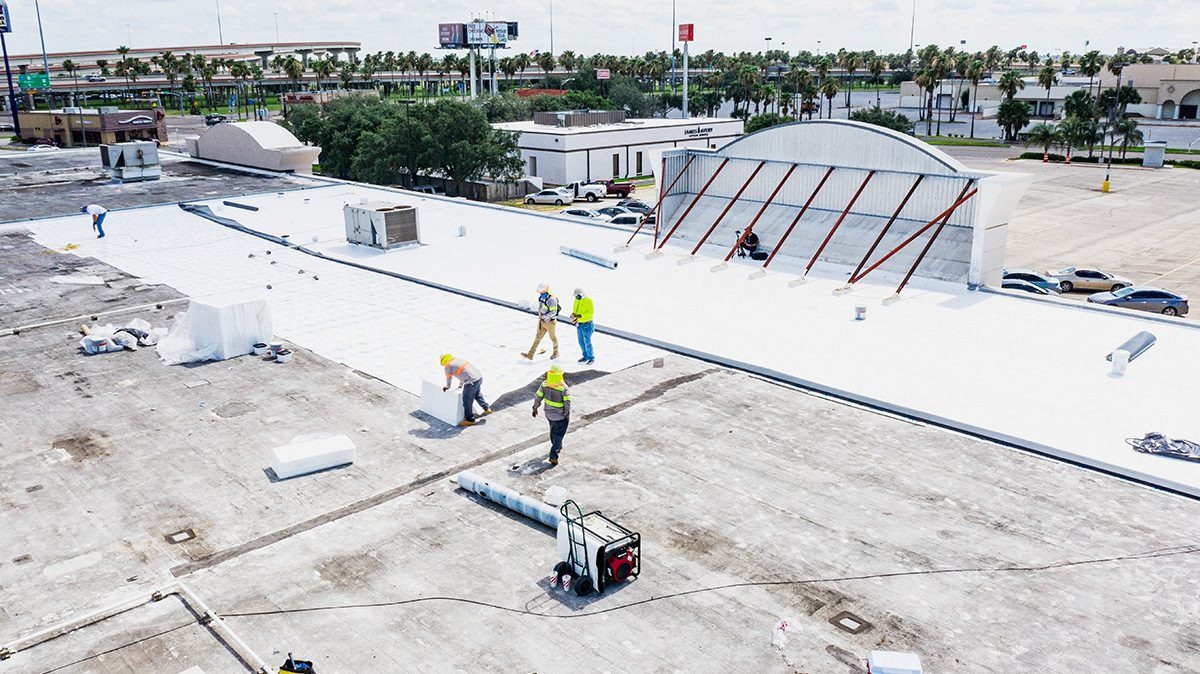
Commercial Roof Expansion Joint Repair in Minneapolis, MN
Minneapolis commercial buildings move more than buildings in warmer climates — a 120°F seasonal temperature swing creates thermal movement at expansion joints that cheap cover assemblies cannot tolerate. Expansion joint failure here is not a maintenance inconvenience; it is a chronic leak source.
Expansion joints on Minneapolis commercial flat roofs handle more thermal movement than expansion joints on comparable buildings in Houston or Phoenix. The annual temperature range in the Twin Cities — from -25°F in January to 95°F in July, with surface temperatures at roofing membrane pushing 145°F in direct sun — means that the building structure, the deck, and the roofing assembly are all expanding and contracting through a range that is roughly double what southern commercial buildings experience. Expansion joints are designed to accommodate that movement. When they fail, the chronic leak that follows is one of the most frustrating diagnostic problems on a commercial flat roof: the leak location is at the joint, the joint runs across the roof, and the water entry point can be anywhere along its length.
We repair and replace expansion joint cover assemblies across the Minneapolis commercial building stock: the 1970s and 1980s downtown office towers that are on second or third expansion joint cover assemblies after the originals failed, the North Loop warehouse-to-office conversions where expansion joints were added during structural seismic and load upgrades, the suburban corporate campuses in the Eden Prairie corridor where large-footprint single-story buildings require multiple expansion joints to accommodate the full thermal movement of 200,000+ sq ft under-roof plate.
The core of our expansion joint scope is the cover assembly — the metal and membrane element that bridges the joint gap and sheds water while accommodating movement. We install factory-engineered expansion joint cover systems from manufacturers whose products are rated for the movement ranges that Minneapolis temperature conditions produce. We do not fill expansion joints with caulk — that approach fails within one to two Minneapolis winters and converts a repairable joint into a larger scope.
Expansion Joint Cover Assembly Failure Modes in Minneapolis
Metal cover fatigue: Aluminum expansion joint covers on Minneapolis commercial roofs fatigue at the bend radius — the point where the flat cover section transitions to the vertical leg that anchors in the membrane. In a Minneapolis building cycling through 120°F of annual temperature change, this bend point flexes 10,000+ times over a 25-year building life. Fatigue cracking at the bend radius is the primary metal cover failure mode. When the bend radius cracks, the cover section separates at the joint and water infiltration begins.
Bellows membrane failure: Many commercial expansion joint systems use a factory-fabricated elastomeric bellows — a flexible membrane element that spans the joint gap and accommodates movement while maintaining waterproofing. Minneapolis freeze-thaw cycling accelerates bellows aging: EPDM bellows becomes brittle at low temperatures and can develop craze cracking after repeated cycling below -20°F. Neoprene bellows are less freeze-tolerant than EPDM. We replace failed bellows with factory-compatible elastomeric systems rated for Minneapolis temperature ranges.
Anchor clamp and fastener failure: Expansion joint cover assemblies are anchored to the roof system by clamping bars fastened through the membrane into the deck or blocking. Fastener corrosion in Minneapolis — driven by the salt-laden snowmelt that gets tracked onto rooftops from surrounding roadways and parking structures — can compromise anchor capacity. When the anchor system fails, the entire cover assembly becomes a loose element that allows water infiltration at every movement cycle.
Ice accumulation in joint gap: The expansion joint gap — typically 2–4 inches wide on commercial buildings — is a natural ice accumulation point. Ice that forms in the joint during winter and then thaws during a warm spell forces water into the joint gap at the bellows-to-deck transition. On buildings where the joint gap geometry creates a persistent ice accumulation pattern, we recommend self-regulating heat tape along the joint as part of the cover assembly installation.
Repair and Replacement Procedures
Cover assembly assessment: We walk the full length of every expansion joint on the roof and photograph the cover at regular intervals. We probe the cover-to-membrane transition at the anchor points to assess anchor integrity. We inspect the bellows for surface cracking, delamination, and tear at the bellows-to-cover connection. We document the joint gap width against the cover assembly's designed movement accommodation range — a joint that has moved beyond the cover's design range needs a cover with a larger accommodation capacity, not just a replacement of the same specification.
System replacement: We remove the failed cover assembly in sections, inspect the deck and blocking at the joint for water damage from years of infiltration, repair any deck damage, and install the replacement cover system. Factory-engineered systems from manufacturers like Balco, Migutan, and Sika Emseal are our standard specification — these systems are engineered for the movement and temperature ranges that Minneapolis commercial buildings produce. Installed cover sections are lapped and sealed at connection points, and the cover-to-membrane transition is integrated into the main roof membrane system with compatible flashing.
Transition flashing at expansion joint terminations: Every expansion joint terminates at a parapet wall or at a roof penetration. These termination details are the highest-failure-rate points on an expansion joint system — the transition from the planar joint cover to the parapet wall face requires a flexible detailing that accommodates both the horizontal joint movement and the vertical parapet movement from freeze-thaw. We install flexible transition flashing at every termination point and document the installation with photos keyed to the joint diagram.
Minneapolis Building Stock — Expansion Joint Inventory
Downtown office towers (1970s–1990s): The IDS Center-era office towers and the surrounding Class A stock from that construction wave have multiple expansion joints — vertical building expansion joints that run from foundation to roof and horizontal joints at structural setbacks and podium-to-tower transitions. Roof-level expansion joint covers on these buildings are typically 30–50 years old and are on replacement cycles. We have completed expansion joint replacement on multiple buildings in the Nicollet Mall and South Sixth Street corridors.
Large-footprint suburban and industrial buildings: Corporate campuses in Eden Prairie, distribution centers in Fridley and Brooklyn Park, and light industrial buildings along Highway 55 in Golden Valley and Plymouth are common expansion joint repair clients. Large-footprint single-story buildings require multiple expansion joints across the roof plane to accommodate the full thermal movement of the building's length and width. A 400-foot-long single-story building in Minneapolis that was built without expansion joints will develop a structural crack at the deck level within 10–15 years — expansion joints are the solution, not the problem.
North Loop warehouse conversions: When warehouse buildings in the North Loop were converted to office and hospitality uses in the 2000s and 2010s, structural seismic and load upgrades sometimes required new expansion joints cut into the existing deck. These joints were installed into existing roofing systems and the cover assemblies are now on first-replacement cycles. We have experience with the specific geometry of cut-in expansion joints on plank-deck North Loop buildings.
How do I know if my Minneapolis building's expansion joint is causing a roof leak?
The diagnostic sign is a leak that tracks along a line across the roof — water stains on the interior ceiling that form a linear pattern corresponding to the joint location. Expansion joint leaks also tend to appear or worsen during temperature transition events (early spring thaw, first major cold snap in fall) when the thermal movement is greatest. If you see a linear ceiling stain pattern below a known expansion joint location, it is almost certainly the expansion joint — not a coincidental membrane failure in the same area.
Can expansion joint repair be done on an occupied Minneapolis building in winter?
Cover assembly replacement can be done in winter with appropriate temperature controls. Factory-manufactured expansion joint cover systems are installed with mechanical fasteners and compatible sealants — we use sealants rated for cold-temperature application and pre-warm the cover sections before installation in temperatures below 20°F. We do not install water-activated or water-based sealants in winter. Interior access for deck inspection at the joint is coordinated with the building's facility manager.
What does expansion joint cover replacement cost on a Minneapolis commercial building?
Expansion joint leaking on your Minneapolis commercial building?
Our project managers will walk the full joint, document cover assembly condition, probe anchor points, and produce a written replacement scope — with a factory-engineered system specified for Minneapolis thermal movement ranges.
- Drone Roof Inspection
- EPDM Roofing
- Drain Cleaning Repair
- Capital Planning Support
- Multifamily Roofing
- Storm Damage Roof Repair
- Self Storage Roofing
- About