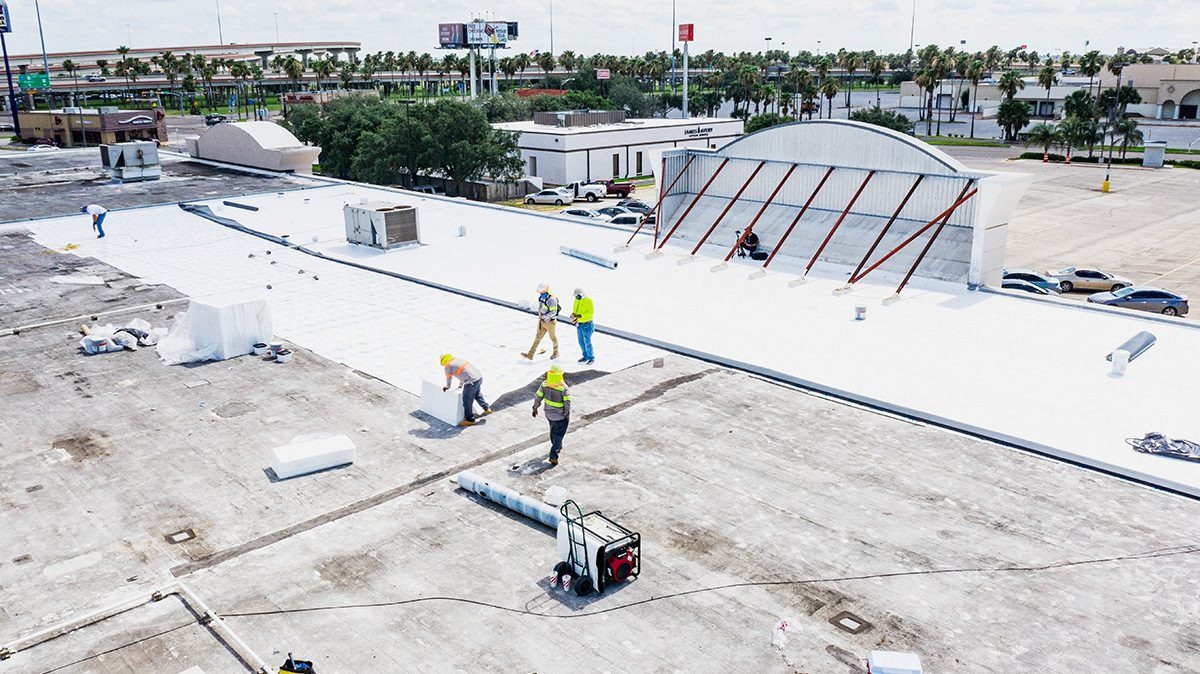
Commercial Roof Condition Reporting in Minneapolis, MN
A written roof condition report from a Minneapolis contractor who has walked the roof, pulled cores where needed, and documented what is actually there — not a checklist completed from the parking lot — is the starting point for any credible capital, insurance, or transaction decision.
Roof condition reports are requested for four reasons in the Minneapolis commercial real estate market: capital planning (the building owner needs to know how many years are left on the current system and what the replacement will cost), insurance (a wind or hail event has occurred and the building owner needs documentation of pre- and post-storm condition to support a claim), loan due diligence (a lender or buyer's representative is requiring third-party documentation of roof condition before closing), and tenant disclosure (a commercial lease requires the landlord to document roof condition at lease commencement). Each of these uses requires a different level of documentation detail, and we calibrate the report format to the specific use case.
Our condition reports are written by project managers who have hands-on commercial roofing installation and repair experience in the Minneapolis market — not by inspection-only staff who have never installed a membrane or managed a warranty closeout. That background matters when the report is assessing whether a flashing failure is a maintenance repair or a pre-existing defect, whether a membrane condition warrants a recover recommendation or a replacement recommendation, or whether a post-storm impact pattern is consistent with hail vs. thermal stress. Those calls require construction knowledge, not just inspection checklists.
The report documents roof area (measured), system type, system age (based on permit records where available, contractor records where available, or visual assessment where records are not available), membrane condition by zone, flashing condition at parapets and penetrations, drain condition, insulation condition assessment (visual plus core sampling where indicated), snow load and drainage adequacy, and a condition rating with remaining useful life estimate and maintenance and replacement cost projection in current-year Minneapolis market pricing.
Condition Report for Capital Planning
Capital planning condition reports for Minneapolis commercial buildings are the most detailed format we produce. In addition to the standard condition inventory, capital planning reports include: moisture core sample results with locations mapped on a roof diagram, insulation R-value assessment for current energy code compliance, snow load documentation cross-referenced against the building's structural design load, drain coverage area analysis, parapet height vs. design snow depth assessment, and a 5–10 year maintenance and replacement cost projection with recover-versus-replace analysis at the projected replacement decision point.
Minneapolis building owners in the Calhoun-Isles neighborhood, the Nicollet Island area near the Stone Arch Bridge, and the Seward neighborhood near the Franklin Avenue commercial corridor have commissioned capital planning reports when they were preparing to refinance and needed credible roof documentation for the lender's due diligence process. The reports provided the remaining useful life estimates and replacement cost projections that lenders use to evaluate whether escrow reserves are adequate.
The capital planning report format also serves Minneapolis commercial building owners who are evaluating whether to sell or hold a building. Understanding the roof's remaining life and replacement cost changes the hold-versus-sell calculation — a building with 3 years of roof life remaining that needs a $400,000 replacement is priced differently than a building with 15 years of roof life remaining, and the condition report provides the documentation to support that differentiation in a transaction.
Condition Report for Insurance Claims
Insurance condition reports for Minneapolis commercial buildings follow a specific documentation protocol: pre-storm condition is established from prior inspection records (if available) or assessed from the pattern of existing deterioration vs. new damage; storm damage is documented with date-stamped photography of each impact location; impact size, density, and distribution pattern are measured and mapped; and the damage is compared against the applicable storm event data (National Weather Service reports, local Doppler radar, and third-party weather certification from services used by the insurance industry in Minnesota).
Minneapolis commercial buildings in the path of the significant hail events that track along the I-94 and I-35W corridors from the southwest have had roof conditions documented by our teams within 24–48 hours of the storm event. The documentation standard we follow — impact measurement, pattern mapping, photo-keyed roof diagram — is the standard that Minnesota insurance adjusters and public adjusters expect to see in a professional roof condition report. We do not provide public adjuster services and do not represent building owners in insurance negotiations; we provide the technical documentation that supports the owner's claim.
For Minneapolis commercial buildings where the pre-storm condition is disputed — the insurer is arguing that the damage is attributable to deferred maintenance rather than the storm event — we document the material failure mode (impact fracture vs. UV degradation vs. thermal stress cracking) and the distribution pattern (random across the roof field consistent with hail vs. concentrated at parapet transitions consistent with maintenance failure). That distinction matters in claims disputes, and the documentation quality determines whether the claim proceeds or stalls.
Condition Report for Transaction Due Diligence
Transaction due diligence condition reports in the Minneapolis commercial real estate market are used by buyers, lenders, and their representatives to evaluate roof condition before closing. The report format for transaction use includes: system age and condition summary, remaining useful life estimate with confidence rating, near-term maintenance items (within 12 months), medium-term capital requirements (1–5 years), and replacement cost projection — all documented in a format that title companies, commercial lenders, and commercial real estate attorneys in Minneapolis recognize.
Minneapolis commercial transactions — particularly in the active North Loop, Uptown, and Midtown commercial corridors — frequently include roof condition reports as a closing condition. We provide reports within the due diligence period, typically 5–10 business days from the inspection date for standard-complexity buildings. Rush turnaround (2–3 business days) is available for transaction-critical situations.
For multi-building portfolio transactions in the Twin Cities market — private equity and institutional buyers evaluating portfolios of 5 to 20 Minneapolis commercial buildings — we provide a consolidated condition summary that ranks all buildings by condition severity and capital urgency, supported by individual building reports. The consolidated summary gives the buyer's investment committee a portfolio-level roof capital picture without requiring them to read twenty individual reports before the due diligence period closes.
How long does a roof condition report take to produce?
Do your condition reports include moisture core sampling?
Core sampling is included in capital planning reports and is available as an add-on to insurance and transaction reports where the moisture condition of the insulation is relevant to the report's purpose. Core sampling adds 1–2 days to the inspection and report timeline. For transaction due diligence reports, we recommend core sampling on any roof system over 15 years old or any system with visible surface distress — the cost of core sampling is small relative to the value of knowing the insulation condition before the transaction closes.
Is your condition report accepted by Minneapolis-area commercial lenders?
Our reports are accepted by commercial lenders active in the Minneapolis market, including regional banks and national commercial real estate lenders. If a specific lender has a required report format or certification requirement, provide that requirement at the time of engagement and we will confirm whether our report can be formatted to meet it. Lender-specific formats — including ASTM E2018 Property Condition Assessment addenda for roofing — are available on request.
Order a roof condition report for your Minneapolis commercial building.
Our project managers will inspect the roof, document the condition with photo-keyed reporting, and deliver a written report calibrated to your use — capital planning, insurance, transaction, or lender due diligence.
- Commercial Roof Coatings
- Roof Leak Repair
- Roof Replacement Planning
- Self Storage Roofing
- Government Building Roofing
- EPDM Roofing
- Retail Roofing
- About