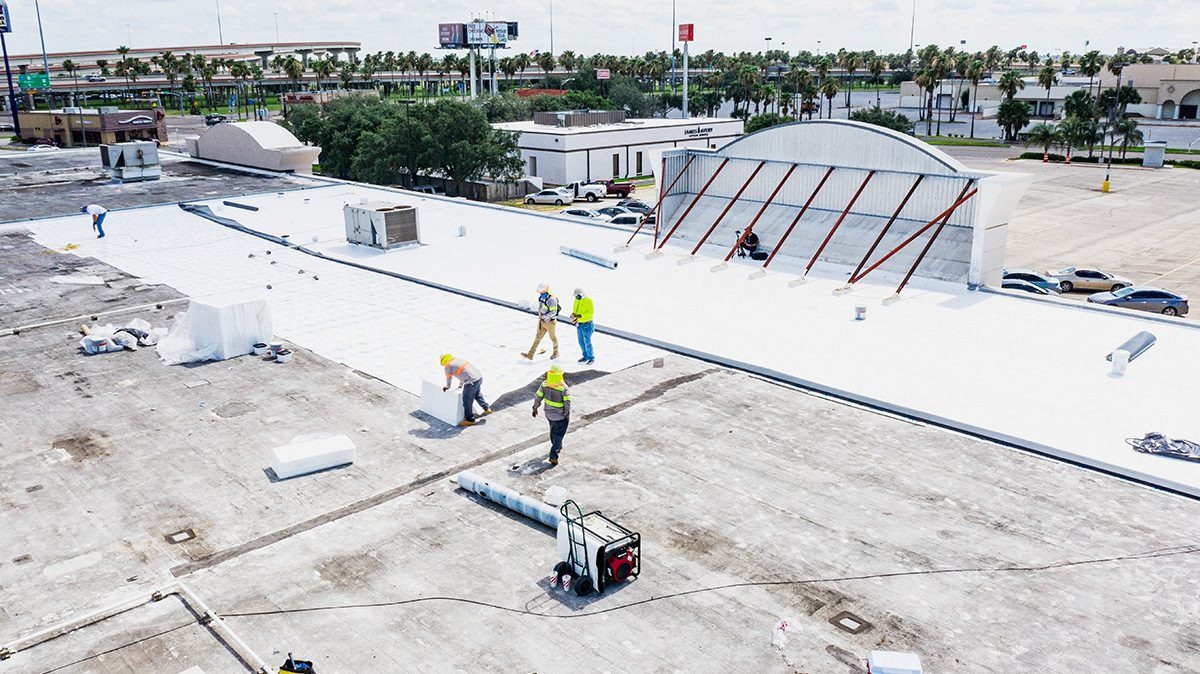
Commercial Re-Roofing in Minneapolis, MN
Commercial Re-Roofing for commercial buildings across Minneapolis.
Most commercial roof replacements in the Twin Cities metro get scoped reactively. The roof leaks in March after an ice dam season, someone calls three contractors, and the lowest bid wins. That replacement runs the same membrane on the same insulation against the same parapet detailing — and then ice-dams again in eighteen months. We do not work that way.
Our replacement scope starts with a roof walk and moisture-core pulls on any roof we suspect has saturated insulation. We document deck condition, parapet flashing condition, drain status, every penetration, and every prior repair. Minneapolis commercial roofs require snow load analysis: we cross-reference the building's structural design load (typically 35 psf ground snow load for the metro, 40–50 psf in some jurisdictions) against the actual roof drainage plan and slope configuration to identify areas where snow accumulation can exceed design loads.
The deliverable at closeout is the warranty document, the roof zone diagram with all closeout photos, the maintenance contract specifying annual inspection requirements, and a written record that the next reroof cycle can build against. We include the snow load documentation so that the next owner or capital planner can verify the roof was designed for Minnesota's actual conditions.
When Replacement Is the Right Call
Recover-versus-replace is the first decision in any aging-roof scope. We pull moisture cores in five to ten representative locations on roofs we suspect have insulation saturation. Saturated polyiso insulation in a Minneapolis building loses its R-value in winter — a 35-psf snow load on wet, collapsed insulation is a structural risk, not just a warranty issue. If more than 25% of cores read wet, replacement is the honest scope.
Deck condition is the second decision. We pull deck inspection ports under wet cores and at deflection points. In older Minneapolis warehouse buildings — particularly the North Loop and Northeast Minneapolis industrial stock from the 1920s through 1960s — we find wood plank decks, steel deck with corrosion from decades of ice dam infiltration, and concrete decks with rebar exposure at drain penetrations. Deck replacement moves the project into a different cost band and sequencing plan. Owners need to know this before the project starts, not when the crew opens up the roof in February.
Snow Load Design and Drainage Planning
Minnesota State Building Code requires commercial roof structural design for ground snow loads of 35 psf across the Twin Cities metro (higher in some suburban jurisdictions). Actual roof design loads account for drift accumulation at parapets, mechanical equipment screens, and rooftop penthouses — these drift loads can exceed 60 psf in the right conditions. Our replacement scopes include a drainage review that confirms slope-to-drain paths are adequate to move meltwater off the roof before it refreezes.
Ice dam formation is a roof system design problem, not just a maintenance problem. Proper insulation R-value (current Minnesota energy code requires R-30 minimum for low-slope commercial roofs, with prescriptive tapered insulation packages for better drainage) prevents the differential melt that creates ice dams at parapet walls. When we specify the insulation stack for a replacement, we are solving an ice dam problem at the same time we are solving an energy code problem.
Pre-construction: Permits filed with the relevant municipality (City of Minneapolis, Hennepin County, Eden Prairie, Bloomington, etc.), pre-job meeting with the building's facility manager to set material lay-down zones and snow removal coordination for winter projects, tenant notification distributed.
Production: Tear-off staged in 5,000–10,000 sq ft sections with same-day dry-in on each section. In the Twin Cities, we track the National Weather Service forecast daily — a 40% chance of November rain is a hard stop on open tear-off. Crews work to get each day's open area dried in before the afternoon temperature drop accelerates deck moisture absorption.
Closeout: Punch walk with the building's facility manager and our project manager, manufacturer warranty inspection with the manufacturer's field rep, closeout package delivered (warranty document, photo-keyed zone diagram, snow load documentation, maintenance contract, manufacturer start-up documentation).
Can you do a commercial roof replacement in a Minneapolis winter?
Yes, with the right sequencing and materials. TPO and EPDM can be installed in cold weather with modified adhesive formulations and heater-equipped welding guns rated for cold-weather use. We do not schedule tear-off during periods of forecast precipitation or when substrate temperatures are below the adhesive manufacturer's minimum application temperature. Cold-weather production is slower and requires more careful substrate preparation, which is reflected in the project schedule and budget.
How do you handle snow accumulation on the existing roof during a replacement project?
We coordinate snow removal as part of the pre-construction plan for any project that runs through the snow season (typically November through March). We have relationships with qualified roof snow removal contractors and can include snow management as a line item in the project scope. We do not tear off a roof section that has snow accumulation against the structural design load — that is a safety and structural risk.
How long does a typical Minneapolis commercial roof replacement take?
For a 50,000 sq ft single-story commercial building with no deck replacement and no major demo: about 3–4 weeks of production in summer months. Winter projects add 20–30% production time due to weather holds, substrate preparation requirements, and shorter working days. We give a written production schedule before contract signing, with weather contingency days explicitly accounted for.
Get a written replacement scope for your Minneapolis building.
Our project managers will walk the roof, pull moisture cores if the recover-vs-replace decision depends on it, and deliver a written scope that includes snow load analysis, drainage review, and manufacturer warranty path.
Commercial Re-Roofing in Minneapolis, MN begins with a structural load check. Before any tear-off is priced, the building's roof deck capacity must be verified against the weight of the proposed new assembly — new insulation, cover board, membrane, ballast if applicable, and any required drainage improvements. For commercial re-roofing in Minneapolis, the code also controls how many membrane layers can remain on the deck: most jurisdictions follow the two-layer maximum specified in the International Building Code, which means full tear-off may be required even when the top membrane looks serviceable.
Insulation is the largest cost driver in commercial re-roofing after tear-off labor. Energy codes in MN — whether Title 24, ASHRAE 90.1, or a local supplement — set minimum R-value targets for roof assemblies above conditioned space. A commercial re-roofing project that does not meet the current energy code may require additional insulation thickness to obtain a permit, which changes the scope, the deck load, and the tapered insulation design around drains. Commercial Roofing works through those calculations before presenting a commercial re-roofing budget so the number in the estimate reflects the actual permitted scope.
Permit documentation for commercial re-roofing in Minneapolis typically requires product data sheets, a roof plan or sketch showing drainage and slopes, a disposal plan for tear-off material, and sometimes a structural engineer review letter when the new assembly is heavier than the existing one. We assemble that documentation package and coordinate with the building department on the inspection schedule so the commercial re-roofing project closes without a certificate-of-occupancy hold.
Warranty implications matter for commercial re-roofing decisions. A roof manufacturer will not extend a new system warranty over a tear-off site with an unaddressed deck repair or compromised substrate. We document deck conditions found during tear-off, provide photographic evidence of substrate quality, and give ownership the information needed to decide whether manufacturer warranty coverage is worth the additional substrate repair cost. Call or email to schedule a commercial re-roofing assessment in Minneapolis.
Widespread wet insulation, a second membrane layer already present, deck deterioration, repeated failed repairs, and energy code compliance gaps on a permit-requiring scope all push toward full re-roofing.
ASHRAE 90.1 or state-specific energy codes set minimum insulation R-values that may require added insulation thickness beyond what the existing assembly provides, increasing both cost and structural load.
Product data sheets, a roof plan or sketch, a disposal plan, sometimes a structural engineer review, and contractor licensing documentation. We assemble the permit package and coordinate the inspection schedule.
Membrane layer count, deck condition found during inspection, moisture scan results, and the code-required maximum layer count all determine whether full tear-off or partial removal is required.
- Expansion Joint Repair
- Industrial Roofing
- Healthcare Facility Roofing
- Solar Roof Integration
- Commercial Roof Maintenance
- Built Up Roofing
- Emergency Roof Repair
- About