Sports & Recreation Roofing in Minneapolis, MN
Sports & Recreation Facility Roofing in Minneapolis, MN
Few places play indoors as hard as Minneapolis does. The winters are long enough that hockey, swimming, and field sports all move under roof for months at a time, and the metro is dense with the buildings that make that possible: Minneapolis Park and Recreation Board rec centers, the suburban community centers and ice arenas across Hennepin County, university field houses and aquatic centers, and the private clubs and indoor sports complexes ringing the city. What ties these buildings together as a roofing problem is the combination of enormous clear-span decks, occupancy-driven moisture and heat, and a program calendar that fills nights, weekends, and holidays, the exact hours most crews would rather not be on a roof.
The clear span is the structural headline. A gymnasium, a field house, or an arena bay can run sixty, eighty, even a hundred feet between supports, and the deck deflects and the wind uplift behaves nothing like it does on a small box. Layer on a winter's worth of accumulated snow load and the fastening design becomes a real engineering question rather than a catalog lookup. We base the attachment on the actual deck type and span, because the same steel deck at eighty feet and at thirty feet are two different pull-out calculations.
The Pool Hall Is the Most Punishing Roof in Recreation
Natatoriums are in a category of their own. Chlorine reacting with organics off swimmers produces chloramine vapor, and chloramine is aggressive toward ordinary metal flashing, aluminum edge, and some membrane adhesives. Over a pool we specify stainless or copper flashing in the chloramine-exposed areas, confirm membrane compatibility against the manufacturer's chemical data, and select adhesives tested for pool-hall service. We also want the ventilation exhausting toward the exterior rather than recirculating above the pool envelope, because trapped chloramine attacks both the roof and the HVAC that serves it.
Indoor Humidity in a Cold Climate
Even away from the pool, the moisture load from heavy athletic occupancy and locker rooms is significant, and in this climate that vapor wants to drive into a cold roof and condense inside the assembly. The vapor retarder has to be positioned for a cold-climate building, not a warm-dry one, and recovering over an existing wet or misspecified assembly only compounds the problem. On any aquatic or high-humidity facility we run a moisture survey before we finalize the reroof scope.
Ice Arenas, Refrigeration, and Roof Deck Frost
Sheets of ice add their own twist. The refrigeration plant under an arena keeps the slab cold, and without correct insulation and vapor management the underside of the deck can frost and drip onto the ice surface. We evaluate the assembly over arena ice with that specific failure mode in mind, separate from how we would treat a dry gym next door.
Skylights, Daylighting, and the Penetrations Over the Court
Field houses and gyms are often daylit, with translucent panels or skylight runs flooding the playing surface, and those assemblies age faster than the membrane around them. Sealant fails, curbs telegraph movement, and in this climate the condensation and snow that collect around a skylight curb find the weak detail first. We evaluate every translucent panel and skylight curb on a recreation roof and replace or reflash where the unit is past its service life, because a drip onto a hardwood court or an ice sheet is both a closure and a liability. Rooftop sound equipment, scoreboards, and rigging supports over an arena bowl get the same treatment as discrete, individually flashed penetrations.
Reflectivity, Energy, and Rooftop Solar
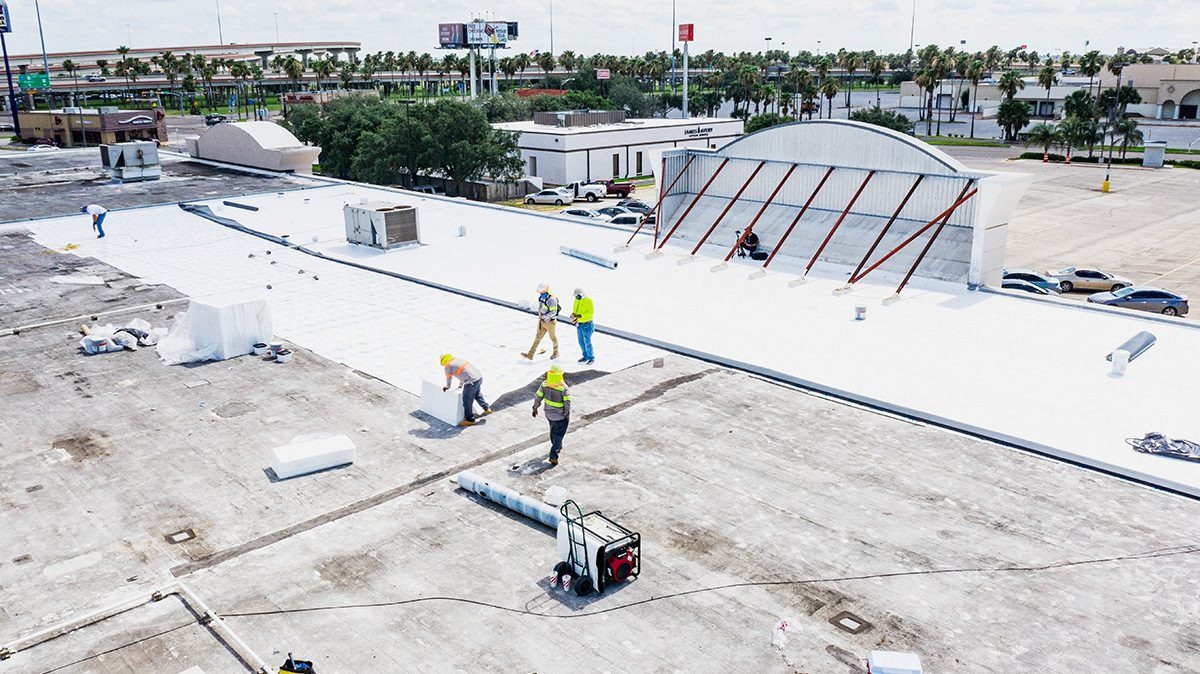
These are big, simple roof planes, which makes them attractive for reflective membranes and for rooftop or canopy solar, and Minnesota's incentive landscape has pushed a number of rec centers and community buildings in that direction. A white TPO or PVC field cuts summer cooling load on a building that fills with bodies and lighting heat, and where solar is planned we coordinate the array attachment and ballast with the membrane and the snow-load math so the panels do not become the thing that overloads or punctures the roof. We would rather design the roof and the array together than retrofit penetrations into a finished membrane later.
Public Procurement and a Full Program Calendar
Many of these facilities are public, run by the city, park districts, or school systems, which brings public bid advertising, bid and performance bonding, and prevailing-wage compliance into the timeline. Private clubs follow a different path but carry equally tight scheduling driven by membership use and event calendars. We carry the bonds and insurance for public work in Minnesota and sequence gym and arena work into daytime weekday hours with daily dry-in confirmed before evening programming begins.
Sports & Recreation Facility Roofing Questions
How do you handle pool and locker-room humidity in the assembly?
We position the vapor retarder for a cold-climate building and survey the existing assembly for trapped moisture before specifying a reroof, since recovering over a wet deck makes the problem worse rather than solving it.
What materials survive natatorium chloramine?
Stainless or copper flashing in chloramine-exposed zones, a membrane confirmed against the manufacturer's chemical-resistance data, and adhesives tested for pool-hall service. Standard specifications are not appropriate over a pool.
How do you schedule around heavy evening and weekend use?
We concentrate gym and arena work in daytime weekday hours and confirm daily dry-in before evening programming. For pools, exhaust and penetration work is coordinated with operations to protect air exchange above the hall.
Do you handle public bid requirements for municipal facilities?
Yes. We carry the bonds and insurance for public work in Minnesota and have worked through the bid advertising, bonding, and prevailing-wage documentation that city, park-district, and school facility contracts require.
What roof system works for a large-span gym?
Typically a 60- or 80-mil TPO mechanically attached over polyiso, with the fastening engineered to the actual deck and span. We provide the deck evaluation and fastener spec as part of every long-span scope.