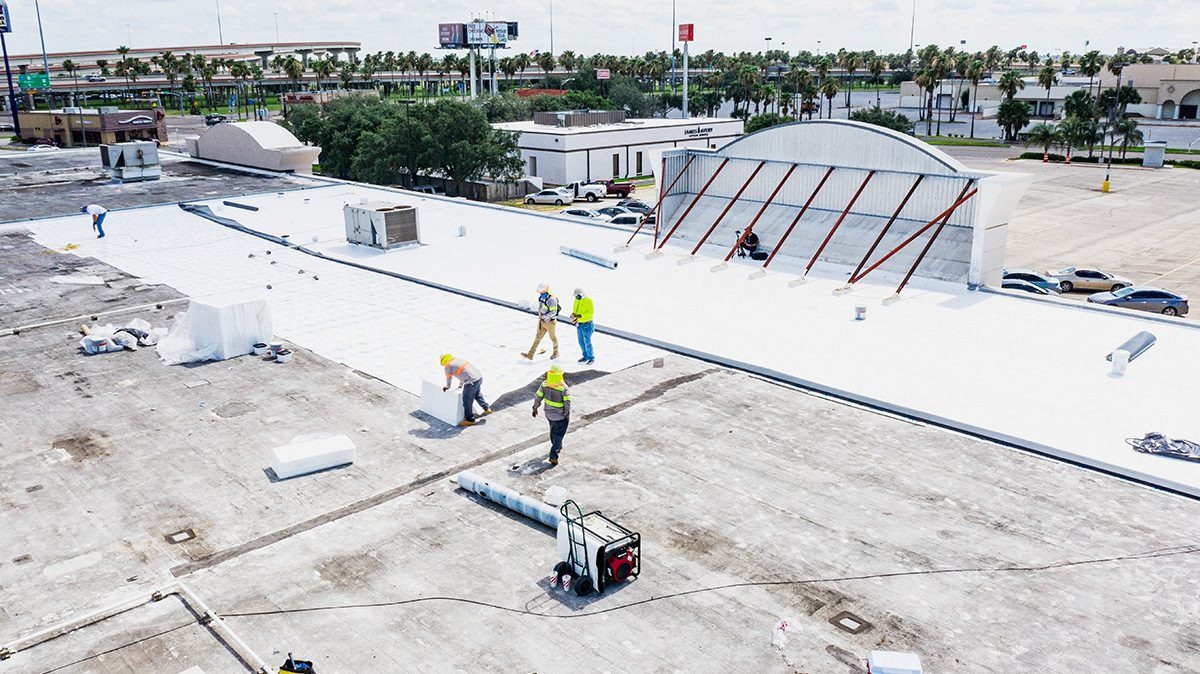
Technology Campus Roofing Minneapolis
The Twin Cities hosts one of the largest concentrations of health-tech and corporate technology employers in the Midwest — UnitedHealth Group and Optum in Eden Prairie, Seagate in the 494 corridor, and dozens of mid-market technology companies across Hennepin and Scott Counties. These corporate campus buildings run mission-critical data centers, trading floors, and claims-processing operations that cannot absorb a roof-leak event.
UnitedHealth Group's corporate campus in Eden Prairie, off Optum Way and the I-494 corridor, is one of the largest single-employer commercial roof footprints in the state of Minnesota. The campus spans multiple buildings ranging from early 1990s construction to recent additions, with a mix of flat roof systems that includes original BUR from the first-generation buildings, TPO recovers from the mid-2000s, and newer single-ply on the most recent structures. UnitedHealth Group's facilities management team runs a vendor program with specific insurance, safety, and documentation requirements. We have navigated this program and understand what the facilities team needs before they will authorize a contractor on campus.
Optum, UnitedHealth Group's technology and data analytics subsidiary, occupies significant square footage in the Eden Prairie campus and in several leased buildings across the Twin Cities metro. Optum's operations include data centers and analytics infrastructure where a roof-leak event creates both property damage and potential data-integrity risk. Roof work on or near data-center-adjacent spaces is scoped with watertight-at-all-times protocols — no open membrane section is left exposed overnight, and secondary water-barrier layers are maintained over critical areas throughout production.
Beyond the UnitedHealth Group and Optum campuses, the I-494 tech corridor from Eden Prairie through Bloomington hosts dozens of mid-market technology, insurance-technology, and financial-technology companies in leased corporate campus and Class B office buildings. Most of these buildings were constructed between 1985 and 2005 and are in the recover-vs-replace decision window on their current roof systems.
Mission-Critical Space Roofing Protocols
Technology buildings with data centers, server rooms, and trading-floor infrastructure have a zero-tolerance standard for leak events — not because the roof costs more to work on, but because the contents below are irreplaceable or extraordinarily expensive to recover. Our pre-construction inspection for tech campus buildings includes a meeting with the facilities manager to map the roof above any mission-critical space. Those zones receive continuous secondary protection (typically a water-barrier membrane layer maintained throughout tear-off operations) and are never the last section of a work day.
Occupied-building access controls on corporate tech campuses include badging requirements, escort requirements for certain zones, and security notification for crane and elevated work platform positions. UnitedHealth Group's campus, for example, has security perimeter requirements that govern where contractor vehicles and equipment can be positioned. We coordinate with facilities security before mobilization and build access-control requirements into the production schedule.
Rooftop Infrastructure on Tech Campuses
Corporate tech campus roofs carry more infrastructure per square foot than most commercial building categories. Satellite dishes, cellular antenna arrays, microwave relay equipment, rooftop HVAC systems that serve temperature-sensitive server and trading spaces, and emergency generator exhaust stacks are all common on UnitedHealth Group and Optum campus buildings. We document every piece of rooftop infrastructure during the inspection walk and include equipment protection plans in the pre-construction scope. No equipment is relocated without written authorization from the facilities manager.
Solar arrays are increasingly common on Twin Cities corporate tech campuses — some UnitedHealth Group and Optum buildings carry rooftop solar panels that were installed after the base roof system. Roofing scope on these buildings requires coordination with the solar system's owner and operator: the solar array has to be temporarily de-energized for work in adjacent areas, and the racking system is typically mounted to the roof deck with penetrations that require new flashing details if the membrane is being replaced. We have scoped around solar arrays on corporate buildings and include the racking re-integration detail in the project closeout.
Eden Prairie's 40 psf ground snow load (Scott County specification) affects the snow management planning for large corporate campus roofs. UnitedHealth Group's campus buildings have parapets and mechanical screens that create drift accumulation zones. We calculate design drift loads during inspection and, for buildings on maintenance contracts, establish snow depth thresholds at which the facilities team should initiate snow removal to stay within structural design limits.
Vendor Qualification and Enterprise Documentation
Large corporate tech employers in the Twin Cities have formalized vendor qualification programs. UnitedHealth Group's procurement and facilities management processes require contractor qualification documentation, insurance certificates with specific additional-insured language, safety program summaries, and references from comparable corporate campus projects before a project is approved. We work through these qualification requirements at the front end — the vendor approval process happens before project start, not after contract signing.
Enterprise closeout documentation for corporate tech campus projects goes beyond the standard manufacturer warranty package. We produce a closeout package that includes the warranty document with manufacturer's field rep signature, a GPS-keyed photo log of every penetration and drain on the roof zone diagram, snow load analysis for the building's jurisdiction, a record of all equipment protection measures and their removal at project completion, and a maintenance plan formatted for upload into the client's asset management system.
How do you protect a data center space from water intrusion during a roof replacement above it?
We install a continuous secondary water-barrier layer (typically a self-adhered membrane) over the full area above any data center or mission-critical space before any tear-off begins. This secondary barrier remains in place and is inspected daily until the new primary membrane is fully installed and seamed. We do not remove the secondary barrier until the primary system passes the manufacturer's inspection and we have confirmed watertight status with the facilities manager.
Can you work within UnitedHealth Group's or Optum's vendor qualification process?
What is the ground snow load for the Eden Prairie tech corridor?
Eden Prairie falls within Scott County, which specifies 40 psf ground snow load per Minnesota State Building Code — 5 psf higher than Minneapolis proper. Roof design loads and drift calculations for the UnitedHealth Group and Optum campuses are based on the 40 psf ground baseline. We account for this in every replacement and recover scope we write for Eden Prairie buildings.
Get a roofing scope for your tech campus.
Our project managers will walk the roof, document rooftop infrastructure and mission-critical space locations, and produce a written scope designed to maintain uptime through the full project duration.
- Financial Services Roofing
- Hospitality Roofing
- Agricultural Food Roofing
- Data Center Roofing
- REIT Roofing
- Infrared Moisture Scanning
- Warehouse Roofing
- Occupied Building Reroofing