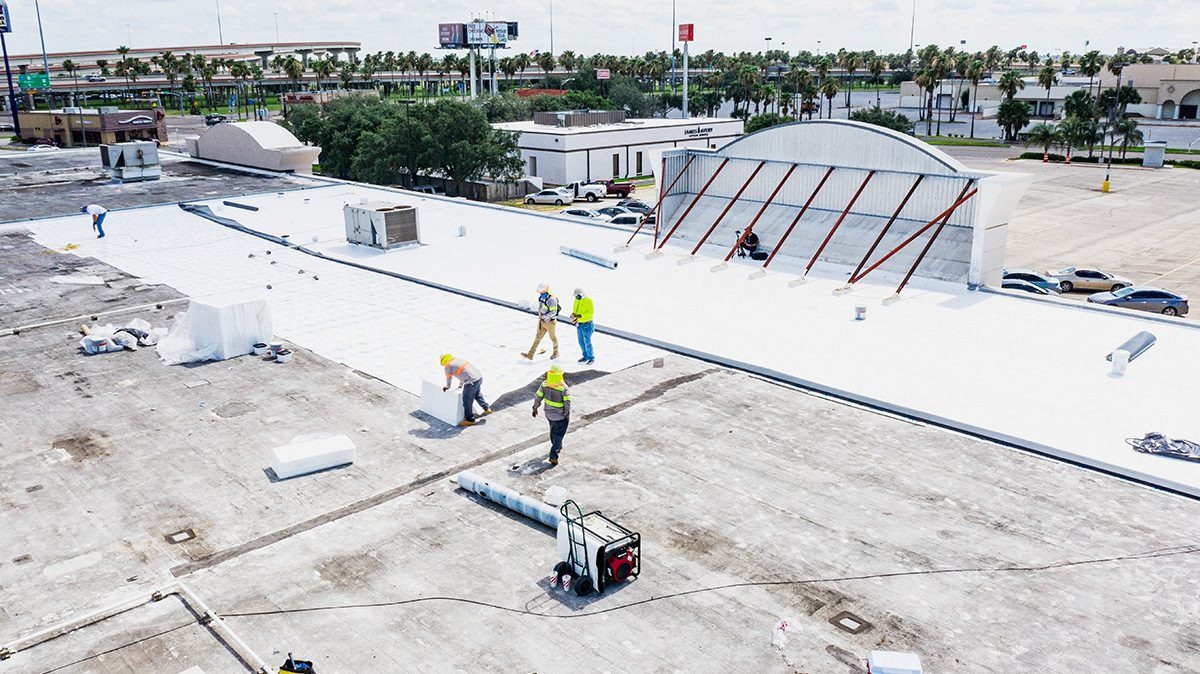
Wind Damage Roof Repair Minneapolis MN
Wind damage on commercial roofs is a function of uplift pressure, not just wind speed. The ASCE 7 uplift zone model — field, perimeter, corner — means that corner and perimeter areas of a roof experience two to three times the uplift pressure of the field. When wind damage occurs on a properly installed roof with correct fastener patterns, it starts at the corners. When it occurs on a roof with undersized fastener patterns or improperly attached edge metal, it can start anywhere.
Where wind damage occurs first on Minneapolis commercial roofs
Edge metal is the most common single wind damage item on Minneapolis commercial roofs — coping cap and drip edge at parapet walls that is attached with adhesive only, or with fastener spacing that exceeds the ANSI/SPRI ES-1 requirement. When the coping cap blows free, the membrane beneath it lifts — the coping attachment detail is the anchor point for the membrane perimeter, and without it the membrane has no resistance to uplift at the edge.
After the May 2024 derecho, the damage pattern we documented most consistently across the Minneapolis commercial inventory was this: coping cap pull-off at corner zones, followed by membrane peel-back at the corners and perimeters exposed to the southwest wind direction. Buildings on open sites — the North Loop warehouse district and the industrial buildings along the Hiawatha corridor in Minneapolis — had higher damage rates than buildings in sheltered urban blocks, consistent with their higher wind exposure classification.
Mechanically attached TPO and EPDM roofs installed before 2015 in the Twin Cities market frequently have fastener patterns designed to earlier ASCE 7 editions with lower wind-uplift requirements. When we repair wind damage on these roofs, we calculate the wind-uplift requirement from the current code (Minnesota Building Code, 2020 IBC-based), and we specify fastener patterns for the repaired and re-secured sections that
Derecho-specific damage patterns in the Minneapolis market
Derecho events produce sustained high-wind conditions that fatigue fasteners differently than a short-duration gust. The May 2024 event maintained winds above 50 mph for approximately 25 minutes across the Minneapolis urban core before the peak gust occurred. That sustained loading period fatigues fasteners in the mid-field zone — not just the perimeter — and we found fastener pull-through in the mid-field on several buildings in the North Loop and Northeast Minneapolis that would not have occurred under a brief gust of the same peak speed.
On older Minneapolis commercial buildings with BUR (built-up roofing) systems — and there is a significant BUR inventory in the Downtown warehouse district and the older industrial buildings in North Minneapolis — derecho events cause gravel blow-off that creates both a projectile hazard and an exposed membrane condition. We assess gravel coverage after wind events on BUR-roofed buildings and document both the safety hazard and the membrane exposure condition for the insurance record.
Writing the wind damage repair scope
A wind damage repair scope starts with a complete roof walk — not just the visible damage area from the street. We have documented multiple Minneapolis wind damage repairs where the street-visible edge damage concealed additional membrane lifting on the rear or downwind elevation that was not apparent until the crew accessed the roof. Every elevation of a wind-damaged building gets walked before the scope is written.
The scope distinguishes membrane repair from membrane replacement, identifies insulation replacement requirements where the membrane was open to rain, specifies edge metal replacement to ANSI/SPRI ES-1 current standard, and measures each zone independently. Insurance adjusters can verify the scope item by item against the photo log and zone diagram — we do not write lump-sum wind damage scopes.
How do I know if my Minneapolis commercial roof has wind damage after a storm?
Ground-level indicators include edge metal that is bent, displaced, or missing along the parapet; membrane that is visibly lifted at corners; and interior water at exterior walls after the storm. If NWS Twin Cities recorded gusts above 60 mph at MSP airport or Anoka County during the event, request a post-storm roof inspection even without visible damage — sub-visible membrane lifting at fasteners can allow the next rain event to penetrate.
Is wind damage covered under commercial property insurance in Minnesota?
Windstorm is a named peril in standard commercial property policies. Minnesota does not have a separate hurricane deductible — windstorm deductibles are typically flat dollar amounts. We provide wind damage documentation for insurance claims structured to the format commercial property adjusters use in the Twin Cities market.
Post-storm wind damage inspection.
- Water Damage Roof Repair
- Fire Damage Roof Repair
- Structural Roof Damage Assessment
- Insurance Claim Roof Documentation
- Snow Load Damage Roof Repair
- Retail Roofing
- EPDM Roofing
- Roof Replacement Planning