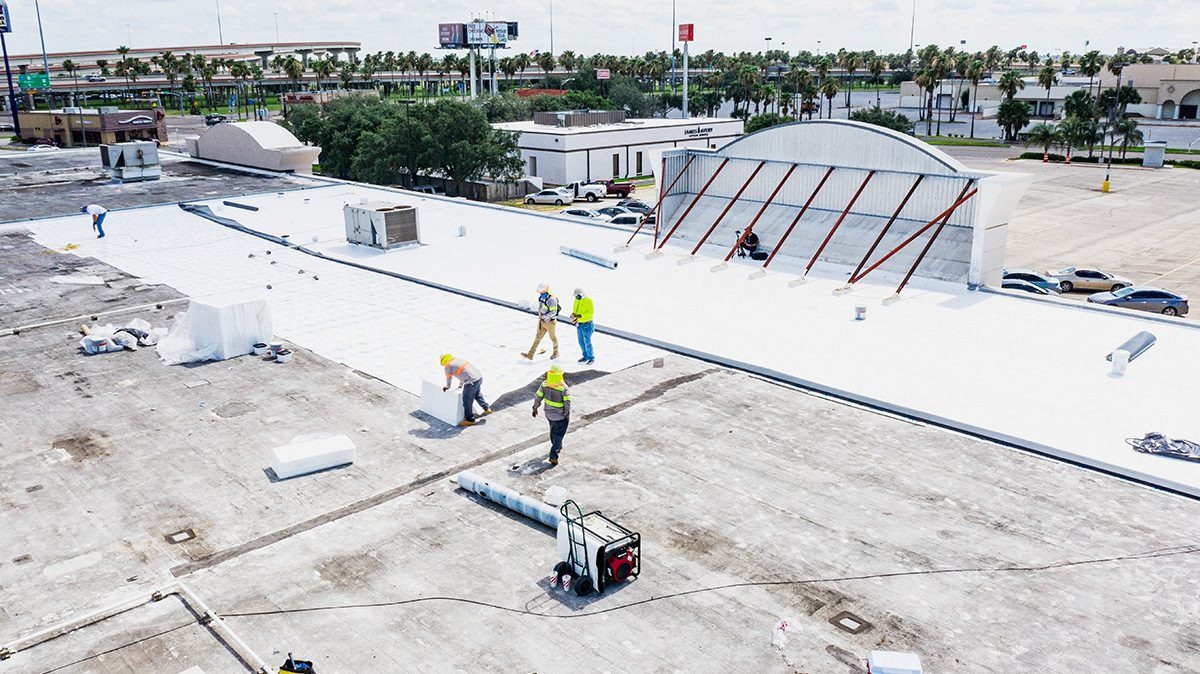
Third-Party Roofing Quality Inspection — Commercial Roofers of Minneapolis
Independent field QA inspection during another contractor's installation — verifying membrane installation, seam integrity, flashing details, and manufacturer warranty eligibility on Minneapolis commercial projects we are not building.
Third-party quality inspection is a specific technical engagement: we walk a roof during or after another contractor's installation, document what we find against the manufacturer's published installation standard and the project's contract specification, and deliver a written report. This is different from owner's representative work, which is an ongoing advisory relationship through the project lifecycle. Third-party QA is a defined scope with a specific deliverable.
We do this on Minneapolis commercial projects for several recurring client types. Out-of-state owners who hired a Twin Cities contractor and want an independent field verification before final payment. General contractors who need documented QA on a roofing subcontractor's installation before they accept substantial completion from the roofing sub. Property management companies whose portfolio managers require independent QA documentation for capital projects above a threshold contract value. And occasionally for owners who are running the project themselves and want a second set of credentialed eyes before the manufacturer warranty inspection.
The inspection is documented to manufacturer-inspection standard. Every finding is photographed, keyed to the roof zone diagram, and cited against the specific manufacturer installation requirement or contract specification section that the condition violates. Findings are categorized as: warranty-jeopardizing (must correct before manufacturer warranty inspection), specification deviation (correction required per contract documents), or observation item (no immediate action required, documented for asset record). Owners receive a report they can hand directly to the installing contractor as a written correction-required list.
Seam integrity: We run probe tests on a representative sample of heat-welded seams — minimum one test per 400 linear feet of seam, plus every seam in a flashing transition zone, every seam within 12 inches of a penetration, and every T-junction. Probe testing identifies cold welds and under-welded seams that pass visual inspection. On a 75,000 sq ft TPO installation, we typically test 700 to 1,000 linear feet of seam. Minneapolis buildings have higher seam stress from freeze-thaw cycling than buildings in warmer climates, so cold-weld detection before the first winter cycle is especially valuable.
Flashing details: Every parapet, penetration, drain, curb, and expansion joint — we photograph each one against the manufacturer's published detail drawing for that system. On Minneapolis commercial buildings, the parapet flashing detail under Minnesota ice dam conditions carries additional manufacturer requirements beyond the standard minimum: termination height above design snow depth, flexible membrane at the wall-to-roof transition to accommodate freeze-thaw movement, and counterflashing lap dimensions that maintain watertight engagement under thermal cycling. We check each of these explicitly.
Fastener pattern: For mechanically attached systems, we pull inspection at the field, perimeter, and corner zones and verify spacing against the approved wind-uplift design. Perimeter and corner zones require significantly higher fastener density than the field — we find fastener pattern errors in these zones on roughly one in three Minneapolis commercial projects we inspect. The error is almost always too few fasteners in the perimeter band, not too many.
Insulation and cover board verification: At accessible inspection points — penetrations, drain sumps, investigation ports — we verify that the insulation type, thickness, and R-value match the specification. We check that the cover board material is compatible with the specified membrane adhesive system. Insulation substitutions that do not meet IECC 2021 R-30 minimum for Climate Zone 6 are a code compliance issue as well as a warranty issue.
Manufacturer Warranty Inspection Support
Most major manufacturer NDL warranty inspections on Minneapolis commercial buildings are conducted by the manufacturer's regional field representative. These inspections produce a punch list of conditions requiring correction before the warranty is issued. The punch list period varies by manufacturer, typically 30 to 90 days.
We support owners and general contractors through manufacturer warranty inspections in two ways. Pre-inspection: we walk the roof and identify probable punch-list items so the installing contractor can correct them before the manufacturer's inspector arrives. The conditions manufacturers flag most consistently on Twin Cities TPO installations — parapet flashing termination height below the Minnesota ice dam standard, under-torqued drain rings, short seam legs at penetration flashings — are identifiable in advance and correctable before the formal inspection. Clearing them before the manufacturer's visit shortens the punch list and accelerates warranty issuance. Post-inspection: we scope and execute the remediation that the punch list requires and submit completion documentation to the manufacturer's warranty desk within the cure window.
The pre-inspection walk is the higher-value service in the Minneapolis market, because the conditions that generate punch lists here are climate-specific and predictable. An experienced inspector who has participated in manufacturer warranty inspections on Twin Cities commercial buildings knows where to look. Finding a parapet flashing termination that is two inches short before the manufacturer's inspector finds it saves the installing contractor a punch-list item and saves the owner a cure-period delay.
Every third-party QA inspection produces a written report delivered within five business days of the field visit. The report includes: an executive summary with overall installation quality assessment and a count of findings by category, the roof zone diagram with findings keyed by number, a finding-by-finding detail section with photograph, location, description, the specific manufacturer installation requirement or specification section violated, and a recommended corrective action, and a findings matrix — a spreadsheet summary sortable by zone, finding category, and priority.
The format is designed to function as a contractor correction list. The installing contractor can pull the findings matrix, assign items to crew members by zone, and return completion documentation by finding number. For owners using the report for pre-warranty-inspection correction, the same format serves as the basis for the pre-inspection walk-through.
Can you inspect a roof installation that is already complete?
Yes, though the most valuable inspection window is during installation — before the membrane covers the insulation, while seams and flashings are accessible for probe testing. Post-completion inspection can still surface visible deficiencies and probe exposed seams, but conditions hidden under a completed membrane require destructive investigation to assess. We recommend scheduling the QA inspection during production on projects where timing allows.
Do you share findings with the installing contractor?
That is the owner's or general contractor's decision. We deliver the report to whoever retained us. They decide whether to share the report directly with the installing contractor, use it as the basis for a written correction-required notice, or hold it for warranty inspection support. We do not communicate findings to the installing contractor without the retaining party's authorization.
What qualifies your inspectors to perform manufacturer warranty inspection support in Minnesota?
Our project managers hold active manufacturer credentials with GAF, Carlisle, Johns Manville, Sika Sarnafil, and Firestone. We know each manufacturer's published installation standard, and we know where Minnesota climate conditions — freeze-thaw cycling, ice dam pressure at parapet walls, cold-weather adhesive requirements — create above-average failure risk within those standards. Our inspectors have participated in manufacturer warranty inspections in the Twin Cities market as the credentialed applicator, so we know specifically what manufacturer inspectors look for on Minnesota buildings.
How long does a QA inspection take on a Minneapolis commercial roof?
Full seam probe, flashing detail inspection, fastener pattern verification, and zone-by-zone documentation: approximately one full day on-site for a building in the 75,000 to 100,000 sq ft range. Buildings with multi-level roof configurations, high equipment density, or complex parapet geometry take longer. We provide a time estimate after reviewing the project documentation before we schedule.
Need an independent QA inspection on a Minneapolis commercial roof installation?
We will walk the installation, probe seams, verify flashing details against the manufacturer's Minnesota installation standard, and deliver a written report the installing contractor can work from before the warranty inspection.
- Roof Zone Mapping
- Maintenance Program Management
- Life Cycle Cost Analysis
- Roof Asset Management
- Condition Reporting
- Auto Dealership Roofing
- Preventive Roof Maintenance
- Parapet Wall Repair